Tig’s Ten Commandments for Engaging in Social Media

I think it is probably true that anyone who starts to engage, or increases their engagement, in social media has a level of uncertainty and insecurity about how to approach this whole area. By social media I include all communication networks, some of the most well known being Twitter, Facebook, MySpace, LinkedIn, FourSquare, blogging and websites. This uncertainty is to be expected, given the rapid rise of these media and the relatively little guidance available to users. Furthermore, taking too much advice from seasoned users may not always be the most advisable route when you analyse their approach.

How people engage in social media reflects their attitude to society and to communication in general. It quickly becomes clear on these networks who are the listeners, who are open-minded, who are generous of heart and those who are none of these.

Before engaging in these channels it is worth noting that social media present us with unveiling and highly revealing forms of communication. This is partly because once you start to engage in one form, say you join Twitter, then your information is automatically shared across other sites you may be involved in, so people can have access to all sorts and sources of information about you. You need to assume that everything online about you is available to everyone. Furthermore, the content of your posts and your responses to others will quickly reveal your level of knowledge and understanding of your area.

In terms of your approach to social media, there are no hard and fast rules – although many people are learning the hard way about what not to do. It is certainly worth thinking about your approach and studying that of others. Social media is[i] after all simply another way of communicating with other real people but on a much larger scale in terms of the numbers and diversity of people, and in terms of the amount of information that is shared. The rules of engagement in a virtual society are no different to those in the more tangible society. Always be considerate of your audience as if they are in the room with you.

There are two huge advantages to be gained from understanding social media and using it well. These are: (1) reaching the maximum audience (in all senses – numbers; breadth of experience, backgrounds and opinions; and location); and (2) engaging in a two-way street for communication. For example, traditionally, marketers have relied on putting an advert in a newspaper or magazine to sell their product – telling you about the product in a ‘look at me’ approach. With more and more media at our fingertips, we are bombarded with so much marketing that the challenge now is to get people’s attention (as stressed by Rick Bakas, the social media guru, in his presentation on 5 April 2011). Social media presents a challenge and opportunity to get attention from a larger audience than we otherwise could (be it for a product, research outlet, discussion forum, whatever) so we need to approach it in the best way to capitalise on this opportunity. Sticking to the old model is not the way for most businesses to survive in this new climate.

Introducing the commandments
I have seen a few of these articles by people telling me what they think are the rules for approaching social media, and I have not yet found any that hit the nail on the head for me. I have put a great deal of thought into this based on practical experience and observation. Feedback as always is welcome! These ten commandments may be applied to Twitter posts, blogs, website updates, comments responding to any of these, and any other form of social media. I use the term ‘posts’ to incorporate all of these.

For those who like the quick cut and dried version, this is it – explanations follow:

  1. Interesting
  2. Interested
  3. Consistent
  4. Correct
  5. Standards
  6. Positivity
  7. Public
  8. Respect and humility
  9. Check, double check and check again
  10. Link across the network

1. Interesting – Make sure your posts are topical, current and reflect at least some degree of originality. If you have nothing to say, don’t say it. Banality is annoying on social media (as in society!). Think about adding in photos (not too many) or videos to keep your posts attractive and to retain the reader’s attention.

2. Interested – Be responsive and show interest in the work of others – this is social media and therefore requires interaction. It is vital to treat it as a two-way street for communication, unlike the traditional media of adverts on TV, radio, in magazines, and so on which have the “look at me, look at me” approach.

It is fairly easy to pick up followers, but it is just as easy to lose them. Remember to thank retweets, comments on your posts, answer queries, engage in conversations and read the work of others and comment on it. Being interested will keep you better informed about your area, and in turn enable you to make your contributions interesting.

3. Consistent – It is important to be consistent in terms of frequency of posts/presence on each form of social media, and also in terms of content – stick with a consistent topic/approach. Before engaging in any form of social media, take time to plan your content, style and approach, and how you wish to be perceived.

To be consistent requires discipline and a business plan-style approach. Your audience needs to be able to see what you are about and why and if you are consistent they will continue to be interested. Bear in mind though that while it is important to maintain a presence it is also important not to swamp your audience with too much material. I have unfollowed people on Twitter for this, have hidden people on Facebook, deleted emails and avoided their posts. This links directly with Commandment 8.

4. Correct – Quite simply – check your facts in your posts and ensure that links are correct. Correct spelling and grammar are also extremely important, linking in with the next commandment.

5. Standards – This commandment is extremely important and far too often broken and in my mind reflects a sloppiness in approach and a level of disrespect for the audience. Standards must be maintained in posts in terms of correct use of language, inoffensive use of language (for example, no swearing or offensive terminology), style, grammar, and correction of typos (they are annoying to read).

Some people on Twitter think it is fine to swear and to post offensive material – they are immediately blocked from my feed. I have come across some blogs (and sometimes from people well-known in their area) that are so badly written that I am almost embarrassed for them. These people need to hire writers or have their worked checked by someone before posting. Not everyone is a great writer. Certainly everyone should not write blogs. Quite simply, people will not follow badly written blogs and will not respond to badly written comments, tweets, etc.

6. Positivity – Ensure that your posts are never offensive. If you dislike something don’t post that. Be constructive not destructive. People have long memories for insults and unpleasant experiences. You want people to want to read what you write. Nobody enjoys reading negative posts. Furthermore, assume that anyone will be able to read any unflattering offerings, which leads to Commandment 7.

7. Public – With any posting of any kind, be prepared for it to ‘go viral’, and assume everyone can see it. Do not ever assume anonymity. Once it is out there you cannot take it back (hence Commandments 8 and 9!)

8. Respect and humility – Respect other people and their work – if you reference someone else’s work, reflect it correctly and provide a valid citation. Praise others where appropriate, and respect their views in discussions – if you don’t agree, there are ways of expressing this constructively. Listen to comments and respond to comments – if you put yourself out there be prepared for responses. Remember the two-way street.

Show humility (this is a human strength not a weakness) – do not act like you know everything, do not tell people they are wrong – discuss do not criticise. It is possible to write in an authoritative way without arrogance. Your audience consists of real people so write in a way that you might explain it to them if they were in the room. Do not simply force your point of view. Even if you know your subject area well, everyone always has something to learn.

Narcissism is rife in social media, both in terms of people pushing their views as being correct but not respecting those of others, and in terms of swamping the various media with too much material.

9. Check, double check and check again – Before posting any tweet, blog, comment, website edit or email, read through what you have written. Ensure it does not break any of the first eight commandments. Ensure that you are not inadvertently writing something which could be misconstrued. This a common error that I have observed. This is a simple yet often overlooked commandment.

10. Linking across the network – Decide which forms of social media you want to be involved in and why and once established, link across them to form a network of interlinking media. This will maximise your audience reach and lead them to the point you want them to go – maybe to read your blog, maybe to visit your Facebook page or website. Include this linking strategy in your business approach. Make sure to include the links on your business card, email signature, websites, etc.

I mulled over this list for a couple of weeks and it works for me but please let me know if you think there should be a number 11!

And a final tip – be committed and enjoy it – if you don’t, it will show!

Tigs

xx 


[i] While the term media is in plural form, the term ‘social media’ is repeatedly being used as a singular term. I acknowledge this, and believe it is one of those rules that will start to be accepted as an exception in the English language.  
Posted in Social media | Tagged , , , , , , | 2 Comments

D’Arenberg – traditional trailblazers ticking all the boxes!

On a cold Wednesday evening in June I went with some friends to a tasting of d’Arenberg wines at Fassina in Somerton Park, Adelaide. Anyone who lives in Australia and drinks wine knows of d’Arenberg and would instantly recognise the red sash across the label and nod knowingly at the consistent quality of their wines. Handed a glass of the Peppermint Paddock as we arrived, a bright purple sparkling chambourcin shiraz with great berry and jube flavours, layers of licorice and spice and a touch of earthiness, with balanced tannins and mineral acidity – this was a great introduction!

Sometimes you need to revisit your established tastes and beliefs – to reaffirm or to adjust what you thought you knew. I have enjoyed d’Arenberg’s wines for many years and have always had a great experience at the cellar door – a must if you visit McLaren Vale. D’Arenberg is known mainly for red wines but also for fantastic whites – and not only for tradition but also for its originality, standing out as a trailblazer in South Australia.

D’Arry Osborn, the wonderful, friendly and warm character and father of the current chief winemaker Chester Osborn, treated us to an array of fun-filled snippets and interesting facts about the winery and its history. He made me laugh out loud when he poked fatherly fun at his son for his renowned wild red hair – “I got my hair cut dad”, he was told, to which he replied, “which one?”. Chester is the fourth generation of this family owned business, established in 1912 – centenary deliciously close!

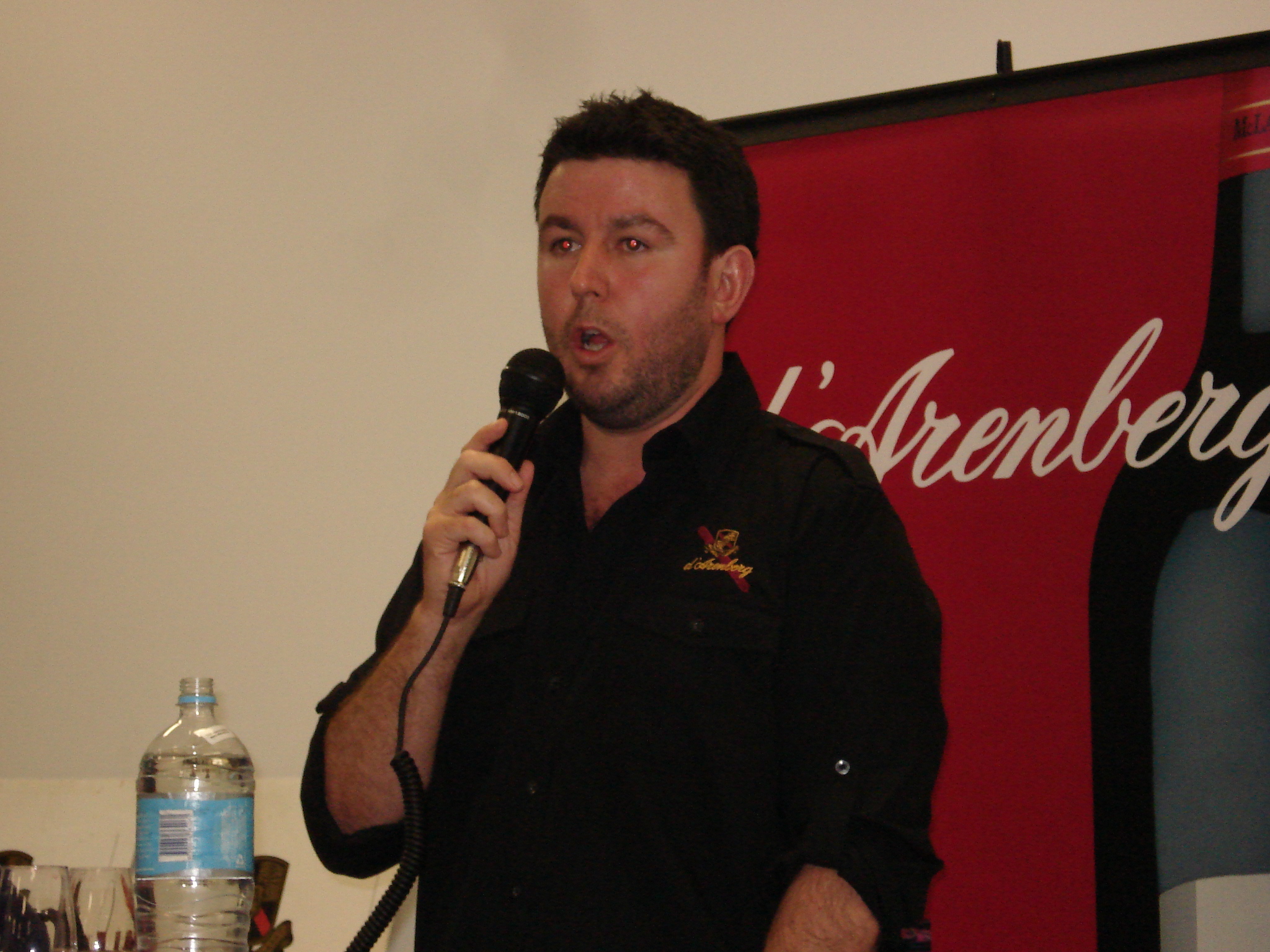
Jack Walton, d'Arenberg Senior Winemaker

The senior winemaker Jack Walton talked us through the wines and took questions, a great speaker, very informative and inclusive. Right from the start he emphasised the d’Arenberg philosophy of minimal input and letting the vineyard come through in the wines. Music to my ears! So to the 15 wines! (full list given at the end of this article)

The whites:
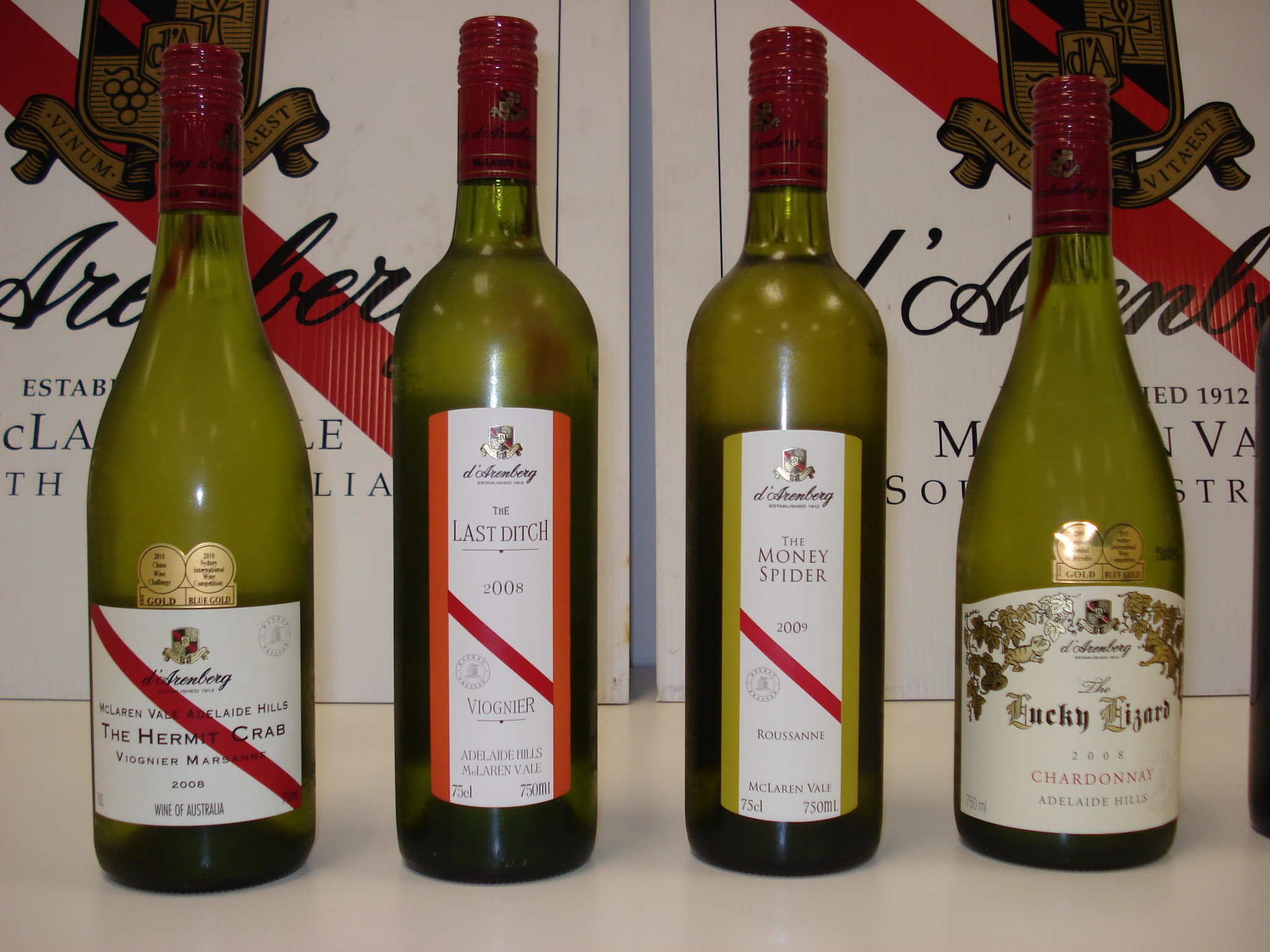
McLaren Vale is not known for whites but d’Arenberg bucks this trend, with the Rhône varieties of viognier, marsanne and roussanne, and a superb chardonnay. All of these wines have a fresh, vibrant nose, followed through with a long viscous and complex palate, with varietal fruit, and a dry, mineral finish, leaving you smacking your lips for more.

d'Arenberg whites on tasting

I have always particularly loved The Hermit Crab, deliciously different to anything else you will see in South Australia, with peach, apricot and zingy ginger and even pistachio, a luscious mouth feel and minerality on the finish. The Lucky Lizard Chardonnay was a fabulous surprise, one of the two wines that d’Arenberg makes from Adelaide Hills grapes (the other being their Feral Fox pinot noir). Pale straw in colour, it was elegant and complex and fresh, crisp and creamy, reflecting the expert winemaking with minimal oak influence, six months on lees and a portion of wild ferment.

The reds:
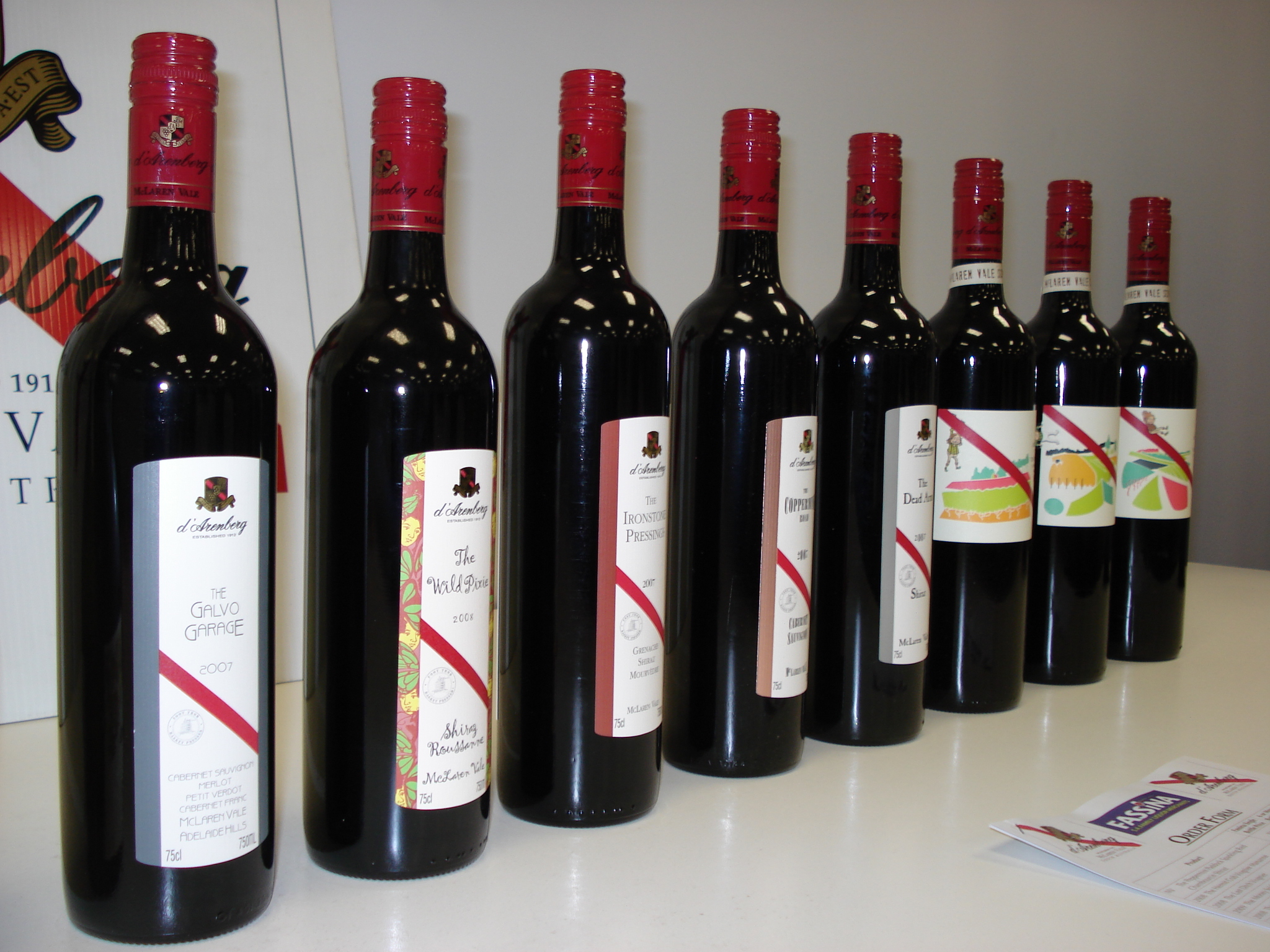
The reds were all made to be bone dry and elegantly oaked so that the fruit is not dominated by oak flavours. Jack tells us that the aim is for complex, elegant, powerful and well-structured wines. Again, music to my ears as I watch in horror some global trends (mentioning none in particular!) towards making sweeter wines and applying almost a factory mentality to winemaking.

d'Arenberg reds on tasting

The nine reds we tasted all lived up to Jack’s description and covered a range of blends as well as the straight shiraz (including single vineyard masterpieces) and cabernet sauvignon. The first two blends were pleasing in very different ways. The 2006 Sticks & Stones with its predominance of tempranillo had a deep, complex and fragrant nose, and on the palate gave red fruits, black cherries, tomato leaf and herbs, with a gamey and earthy edge. As with the reds to follow, the tannins were fine and balanced with minerality, giving an elegant and long finish.

The 2007 Galvo Garage, the classic cabernet sauvignon-dominated Bordeaux blend, treated me to vibrant varietal characters of blackcurrant with a touch of tomato leaf, the merlot adding fleshiness and a touch of forest floor, the petit verdot adding structure and tannin, and the cabernet franc generously giving fragrance, freshness, violets and elegance. This wine is always a real treat. Revisited and reaffirmed!

The 2008 Wild Pixie is an unusual blend of shiraz and roussanne (there is also the more conventional shiraz viognier in the range) giving an intensely dark earthy wine with plum and chocolate and a touch of sweet fruit, backed up by gritty tannins and a long, dry finish. A perfect match for dark chocolate!

The 2007 Coppermine Road Cabernet Sauvignon never disappoints but nevertheless its star quality still surprised me again as I breathed in the earthy, blackcurrant, chocolate and slightly eucalypt bouquet, with a touch of violets. The palate followed through with a varietal and savoury complex treat rounded out with the perfect tannin structure.

The next four wines were 100% shiraz. The Dead Arm Shiraz is an icon of its own merit, enjoyed around the world. A lavender floral edge to the nose with spicy plum and blackberry give way to a powerful, rich, savoury, layered palate with blackberry and cherry and an earthiness rounded out by the balanced tannins. The wine gives the impression of power yet elegance.

Next was my first ever tasting of the three single vineyard shirazes that make up d’Arenberg’s contribution to the McLaren Vale Scarce Earth initiative, launched on 1 May 2011 to showcase single vineyard 2009 shirazes from the region. Seventeen wineries are taking part: Brash Higgins, Chapel Hill, Coriole, d’Arenberg, Five Geese, Fox Creek, Halifax, Hugh Hamilton, Kangarilla Road, Maxwell, Paxton, Penny’s Hill, Primo Estate, Sabella, Serafino, Shingleback and Vinrock.

While only a few hundred metres apart, d’Arenberg’s three single vineyard shirazes all exhibited distinct characteristics. The similarities were in the rich, dry, savoury palate, with a great mouth feel and grippy tannins. On the nose each one differed. The Little Venice had an earthy intensity with gamey aromas and some red fruits, and a touch of pepper at the end. The Fruit Bat was more open and plush with a hint of chocolate on the nose and a more plummy character than the Little Venice. The Eight Iron was beautifully balanced with an earthy licorice and mocha nose, with a hint of violets, and on the palate giving powerful and luscious plum – a brooding and intensely flavoured wine with those fabulous tannins taking your hand and walking you through a long and savoury finish.

All from the 2009 vintage, these wines will certainly benefit from some careful cellaring. All with a RRP of over $100 and no shortage of customers, we were very lucky to taste these gems.

Rounding out the night with the BFF!
The sticky ending the night was the strikingly named 2010 Noble Botryotinia Fuckeliana Semillon Sauvignon Blanc. The name comes from the man Gottleib Fuckel who discovered this particular mould variety. While I don’t generally have a sweet tooth, a noble sticky has never let me down. Dark golden and gloopy, this wine is intense on the nose with honey, lemon, butter and a touch of crisp green apple. On the palate is all the complexity you expect with noble sweet wines – floral, honeysuckle, limoncello, paw paw and a little bit funky. Luscious, smooth, soft and a great end to a memorable evening.

D’Arenberg’s wines are enjoyed in over 60 countries, on cruise ships such as the QE2 and on major airlines including Singapore Airlines and Emirates. The more you learn about this winery and taste its wines, the luckier you feel to be living right next to it and to have access to the colourful people and to the varied and premium quality wines.

The tasting line-up:

  • NV The Peppermint Paddock Sparkling Red Chambourcin Shiraz
  • 2008 The Hermit Crab Viognier Marsanne
  • 2008 The Last Ditch Viognier
  • 2009 The Money Spider Roussanne
  • 2008 The Lucky Lizard Chardonnay
  • 2006 The Sticks & Stones Tempranillo, Grenache, Shiraz
  • 2007 The Galvo Garage Cabernet Sauvignon, Merlot, Petit Verdot, Cabernet Franc
  • 2008 The Wild Pixie Shiraz Roussanne
  • 2007 The Ironstone Pressings Grenache, Shiraz, Mourvèdre
  • 2007 The Coppermine Road Cabernet Sauvignon
  • 2007 The Dead Arm Shiraz
  • 2009 The Little Venice Single Vineyard Shiraz
  • 2009 The Fruit Bat Single Vineyard Shiraz
  • 2009 The Eight Iron Single Vineyard Shiraz
  • 2010 The Noble Botryotinia Fuckeliana Semillon Sauvignon Blanc
Posted in Cabernet sauvignon, McLaren Vale wine, New World wine, South Australian wine, Syrah/Shiraz, Wine events | Tagged , , , , , , , , , , , , , | 8 Comments

International #Chardonnay Day!

Thursday 26 May 2011 was International #Chardonnay Day! I saw this event being advertised by Rick Bakas the first director of social media in the wine industry in April 2011 when he toured Australia, as he kicked off this trend of themed wine days in November 2009 – the first #chardonnay day was in May 2010. Rick’s description of the why and how of these #wine days is explained in his article #Chardonnay Day Recap.

In Adelaide this baton was taken up by the Qwoff Boys and they have done a fantastic job publicising it and getting people involved. In New Zealand, the key contributor was Jayson Bryant. I was absolutely delighted to be invited along to Qwoff HQ to mix and mingle with winemakers, marketers, academics, and general wine lovers to try, to talk about and to tweet about the chardonnays on offer – about 150 of them but who’s counting!

The slideshow below shows just a portion of the wines on offer and the evident fun of the day! The Twitter page for #chardonnay was turning over rapidly, as we could all watch – Andre and Justin had the tweets projected onto the wall for all to see – a great way to remember which were your wines of the night.

The standouts for me and I was in agreement with most of the people I talked to –

Pepper Tree 2009 Venus Block from Orange – soft butterscotch with some mild smokiness on the nose and lipsmacking acid. Superb!

Second was the One Ball chardonnay from BK Wines, 2010 Adelaide Hills – and the winemaker was there to thank! A crisp perry-like nose with soft, slightly nutty palate, which was dry and crisp on the finish with great length.

Third in the Australian line-up in my humble opinion was the Chapoutier 2009 Pyrenees which was the winner of the night for elegance. Crisp, fresh and light, with juicy sweet white peach on the palate, and a long finish.

I have to add a fourth place in my Australian line-up for the Tempus Two 2009 Wilde Chardonnay – the wild ferment from natural yeasts gave it a funky and complex character.

New Zealand was well represented by two chardonnays from Waipara Valley in the South Island – Muddy Water and Greystone – both had great intensity balanced with elegance.

No wonder chardonnay continues to be the most planted grape variety in the world!

This slideshow requires JavaScript.

Posted in Chardonnay, McLaren Vale wine, New World wine, NZ wine, Social media, South Australian wine, Wine events | Tagged , , , , , , , , , , , , , | 3 Comments

Want to know the key issues facing the wine industry? Ask them!

During 2009 I took time out from my economics consulting job with the South Australian Centre for Economic Studies to work a vintage at Haselgrove winery in McLaren Vale. Prior to this I worked in a wine retail outlet in Adelaide and later I started working at Pirramimma winery in McLaren Vale on a regular basis at cellar door and assisting with marketing initiatives and tastings.

The interesting observations I made about the wine industry from insights shared by people I grew to know in the wineries, wine retail outlets and industry organisations, prompted me to start to ask questions about their views and concerns about the wine industry at the grass roots level, rather than at the industry-wide level which is where the analytical conversations and policy decisions usually start.

I thought it would be refreshing to gather anecdotal evidence from the horse’s mouth, giving a voice to people working in the wine industry, with a passion and a history embedded in the wine industry, and with fears, concerns, hopes and ideas that should all get their share of attention.

This Issues Paper that I produced for SACES is a non-biased record of the views of people I interviewed in the South Australian wine industry during 2009. I provide some background of the significance of the South Australian wine sector in the context of the national wine industry and show its extraordinary performance. I asked people why they thought the South Australian wine industry had been so successful, and what might influence its success in years to come. This is their voice.

Read the Issues Paper here:

Identifying the Main Economic Issues Facing the South Australian Wine Industry

Enjoy!

Tigs

(Please note as the author but not publisher I had no control over the overview at the start of the paper, or the comments in the margins or final editing and therefore take no responsibility for these.)

Posted in Barossa wine, McLaren Vale wine, New World wine, South Australian wine | Tagged , , , , , , , , | 2 Comments

Proposal to cut minimum alcohol in ‘wine’

I became aware of the Winemakers’ Federation of Australia‘s (WFA) proposal to cut the minimum alcohol level in wine when I received a call from ABC radio to comment, in my standing as Visiting Research Fellow with the Wine Economics Research Centre and the Wine2030 Network of the University of Adelaide. 

The information source was the Food Standards Australia New Zealand (FSANZ) website, the article entitled Call for comment on proposed change to minimum alcohol content in wine.

I had my own ideas about the reasoning and implications for this proposal but being a researcher, I wanted to check with key stakeholders including the WFA, Wine Australia, winemakers and marketers, so I spoke to all of these groups and came up with a consistent response.

Essentially, wine is defined as having at least 8% alcohol, so if a style is made in such a way that the alcohol falls below this level, then the winery is not permitted to call that product ‘wine’, since under current legislation, this is technically not a wine. It must be called something else, fermented grape juice, for example.

The main styles that would be affected by this change are not our standard wines, where there would not be an issue of alcohol falling below 8%. Rather, sweeter styles of wine such as moscato would be the main focus. It is not uncommon to see these wines have alcohol of less than 8%.

With the popularity – and seems to be growing popularity – of the lower alcohol wines and sweeter sparkling wines, it is not difficult to see why winemakers may want this flexibility in their labelling.

Furthermore, according to the FSANZ article, this change would simply bring Australia’s legislation in line with that of the European Union, which takes a large proportion of Australia’s wine exports. One more barrier removal can only be a good thing!

To the customer the only thing they might notice is that the labelling on their moscato is ‘wine’ – clarity in the wine aisle also has to be a good thing!

Rarely do I see a proposed change and not see a down side, but this time is the exception to prove the rule.

Posted in Wine news | Tagged , , , , | Leave a comment

Oh rot! Diseases mar a bumper season in key winegrape-growing areas of Australia

Australia’s 2011 vintage will be one to cause grapegrowers and winemakers both extremes of emotions. With the exception of Western Australia which has had hot and dry conditions this vintage, there have been nation-wide unseasonably wet and cool conditions.

Being involved in the wine industry in South Australia, as recently as February, everyone I spoke to was expecting a superb and bumper harvest this year. The cooler and more humid summer had resulted in huge green canopies and healthy tasty fruit. The usual problems of heatwaves and water shortages were barely a concern. 2011 was to be a year to remember. Now it will be memorable but not for the same reasons.

Disease has hit the main wine-producing states of Australia much harder than for several decades, although the impact has been by no means uniform. Some grapegrowers have lost a large proportion or even all of their fruit. Meanwhile others have coped much better, depending on their location, the grape variety in question, and the viticultural techniques applied through the season.

The main diseases of concern have been downy mildew, powdery mildew and Botrytis. All three have certainly caused problems across South Australia, with varying impacts by region. McLaren Vale, for example, was relatively disease-free until very late in the season when Botrytis kicked in, while for other regions such as Langhorne Creek and the Barossa, the Botrytis followed downy in the early part of the season affecting baby bunches and foliation, and powdery in the pre-veraison berries. The Riverland also suffered some losses due to downy prior to Botrytis. Some growers are choosing simply to dump their fruit on the ground, a heartbreaking end to what had been a promising vintage.

The good news is that many grapegrowers have followed disease control guidelines throughout the season and have sprayed to protect against disease, so a great deal of the fruit has been spared. Some growers have harvested earlier than they normally would at a lower Baumé in order to have fresh, clean fruit and to beat any diseases reaching the grapes. There is also especially good news for cabernet sauvignon lovers – people I spoke to in Barossa, McLaren Vale and Langhorne Creek all told me that the thicker skins and looser bunches of the cabernet sauvignon grapes meant that this varietal had stood up well to all disease and would be a great 2011 vintage.

Also good news is that the Grape and Wine Research and Development Corporation (GWRDC) and the Australian Wine Research Institute (AWRI) have been active in providing comprehensive and practical information for growers and winemakers in disease prevention, how to identify disease, viticultural advice to follow to minimise risks for next year, and so on. References and fact sheets are available from the GWRDC and AWRI websites. Below is a list of key references:

GWRDC Fact Sheets

GWRDC: Downy Mildew, Questions and Answers

GWRDC: Downy Mildew Monitoring (Viti-Notes) 2005

GWRDC: Powdery Mildew, Questions and Answers

GWRDC: Botrytis, Questions and Answers

GWRDC: Non-Botrytis, Questions and Answers

AWRI: Information on pests and diseases in viticulture

AWRI: Managing Botrytis infected fruit

Posted in Barossa wine, Cabernet sauvignon, Langhorne Creek wine, McLaren Vale wine, New World wine, Riverland wine, South Australian wine, Wine news | Tagged , , , , , , , , , , , , , , , , , | 1 Comment

A great pairing – wine and social media: California’s Rick Bakas tours Australia

Rick Bakas and Tigs, Adelaide, 5 April 2011

Rick Bakas has just completed his two-week tour of four states in Australia, sharing his knowledge about wine and social media, with the title “Not in new media in 2011? Then not in business by 2016”. He is touted as the first director of social media in the wine industry and as such has a great deal of experience and expertise to share.

Rick has a background in marketing and brand promotion. He worked previously for NIKE Inc. where he managed brands such as the NFL’s Denver Broncos, New York Giants and the University of Oregon. He is now a certified sommelier and author, and specialises in strategic branding advice, particularly in food and wine industries, through Bakas Media.

Rick has an impressive record of helping companies such as St Supéry winery in Napa Valley, California, to ramp up their online and promotional activity to boost their image and expand their sales. He introduces concepts to wineries and wine businesses to help them communicate directly with consumers, for example through global online tastings, ‘tweet-ups’ and virtual tours. A range of innovative and thought-provoking examples are given below.

His successful social media activity is illustrated by his Twitter following of over 50,000 and Facebook of around 5,000.

On behalf of Wine2030, I was lucky enough to attend Rick’s event in Adelaide on 5 April at the National Wine Centre, and he also held similar events in Sydney, Perth and Melbourne, all organised by the wine industry body Wine Communicators of Australia.

Key content

While the last two decades have seen rapidly growing internet and cell phone use, with the take-up rate accelerating in the last few years, the expansion will continue in line with the rapidly evolving technology. This all means that people have instant access to information and the amount of information available to them is staggering and growing. This implies three main points:

1 We are all brand curators/stewards of legacy – everything we post online will live on long after us. For example, an advertisement in a magazine, which you may or may not notice as you flick through, and may not be relevant to you at that moment, will end up thrown away after a few days and gone forever. Its useful life is short and it is not available at the moment when it would be most useful to the customer. Online, brand messages live on, they are portable, and they are available in many forms and at the instant when the customer wants it. The marketer can tell their own story as and when they wish, through all forms of online media, and moreover, they can see the metrics of their customer base  – an invaluable tool for any business.

2 Relationships are key – a company should be wary of the balance of building relationships and pushing product promotion. It is easy to turn consumers off and lose their attention. With the inflow we all have these days of emails, updates from Facebook and LinkedIn, tweets, voicemail, and so on, the key question is how to get a customer’s attention.

Rick likened the use and evolution of your involvement in social media to growing grapes – the vines must be planted and nurtured, and only after several initial stages can the grapes be harvested to make wine. The same is true of social media. Patience is the key and you must not expect results instantly. Relationships must be nurtured like the vines.

Ultimately, this attention online can be converted into sales or an actual behaviour as in the merlot example below. Getting the message through is the key to success in marketing your product. To get the message through, you need to get the customers’ attention – and Rick is the expert in the avenues to do this, as shown in the examples below.

The more you care about the community, the more they will care about you and give you meaningful attention. Once you have attention and this is translated into sales or actual behaviour, when people support your brand they will become your brand ambassadors. This is what Rick terms return on attention – a new twist on the traditional business concept of return on investment.

3 Your blog should be the centrepiece of your social media strategy because it is the launch pad for content, be it articles, video clips, photos, discussions, and so on. Other media points to your blog and your blog is linked to your website. Blogs tend to generate more traffic than the website as the content is generally bite-sized, interactive and current.

Rick states that it is not necessary to be involved in all forms of social media but you do need to be aware that your brand may appear on them.

Rick provided some fascinating examples of how to grow your brand through social media, how it pays off over time, and its sheer power and reach. A few examples are summarised here:

Merlot sale

Soon after arriving at St Supéry winery in the Napa Valley, one tweet linking to a 30 second video on YouTube with footage of Rick promoting their merlot, resulted in sales of nearly 300 cases of this wine in 24 hours. The price was slashed from $25 to $12.50 and the YouTube video had a ‘Buy Now’ button – the deal was available for just 24 hours. Rick stressed that this only worked because the winery had been building the social media strategy for at least three months and had gained following by their wine community.

Cooperation between brands

Morton’s restaurant and St Supéry winery helped to boost each other’s image and sales in a joint promotion, as they put short videos on YouTube, and promoted through their websites, Facebook, Twitter, and so on. That month, St Supéry became their number one selling wine through Morton’s.

Growing winery sales

Through his range of social media involvement and leading a company-wide social media strategy, Rick oversaw strong growth in sales at St Supéry. For example, case sales in the first quarter of 2010 jumped by over 90% and the next quarter by over 110%, largely influenced by the social media strategy, in conjunction with some price-cutting of some wines. Furthermore, the level of attrition of wine club members over this time was half the average for the industry. So social media was instrumental in growing sales and also in retaining wine club members (retaining ‘attention’ and loyalty).

Eventbrite

Rick provided examples of events where he has used the site Eventbrite as a tool to organise events, advertise and register members online for free. Furthermore, the site provides him with the metrics and contact details of these attendees – clearly a useful resource for any company to retain details of interested parties. He has organised events and had people pay online and filled 200 places at an upcoming event in California, while he is in Australia touring, having cost him nothing to do this, and all of the information is online, and the tickets are sold out.

Foursquare

Foursquare uses GPS to locate the user and has a number of applications. Rick’s example for the wine industry was to offer for anyone to turn up to the winery and cheek in on Foursquare to get a complementary tasting for two – it is not uncommon to have pay for tastings in the US. The winery can also can track where the customers originate with the brand and collate metrics.

In addition, it is possible to leave ‘tips’ at locations through Foursquare. He says you can go to all of the accounts that carry your wine (only necessary to visit online, you do not physically have to go there), leave a tip, and when someone checks in they will see this tip. For example, at a restaurant, there may be a tip saying – try our Pauletts Polish River riesling with the lemon sole for a perfect wine and food match. 

Airport

Rick showed us a photo he had taken in an airport of a poster from a bank in the US, of which you could take a picture with your smartphone, and send it to a location online to get a free book downloaded. So people can get a free book for the flight. This is another great way to get people’s attention.

The future will move just as quickly!

Rick predicts that by 2014 virtually all cell phones will be smartphones, with GPS and the internet. People will increasingly make buying decisions based on this – on a plane, in a shop or restaurant, or at a winery. The mindset is changing around buying decisions with information immediate and freely available. Marketing has to move with this.

For example, in future, we will be able to take a photo of a wine bottle, use photo recognition, and access information about it, and even buy it, immediately and through secure means. There may also be the option to ‘like us’ on Facebook, ‘follow us’ on Twitter, and whatever else is available by then.

Of course everyone is trying to build their brand online. There are ways to get ahead and get attention. Rick has so many tips – visit Bakas Media, or his blog or follow him on Twitter, and most of all, get involved and media savvy. And start today! Even now with the tricky Australian 2011 vintage you can get a step ahead – why not take a 30 second video of the winemaking, picking the grapes, telling people about the wine and vintage in advance – when the wine comes out the information is already there.

Thanks Rick!

Posted in Social media, South Australian wine, Wine news | Tagged , , , , , , , , , | 2 Comments

An evening with the Super Tuscans on St Paddy’s Day!

On St Patrick’s Day 2011 I was not downing the traditional Guinness or Jameson’s but rather, indulging my love for wine and my love for learning about wine – at Edinburgh Cellars in Adelaide, where Jacopo Pandolfini presented a range of Antinori’s wines. On booking my spot for this tasting, I looked up Antinori Estates and found the connection to the label ‘Super Tuscan’. I was keen to learn more from one of key Super Tuscan producers and of course to taste some examples.

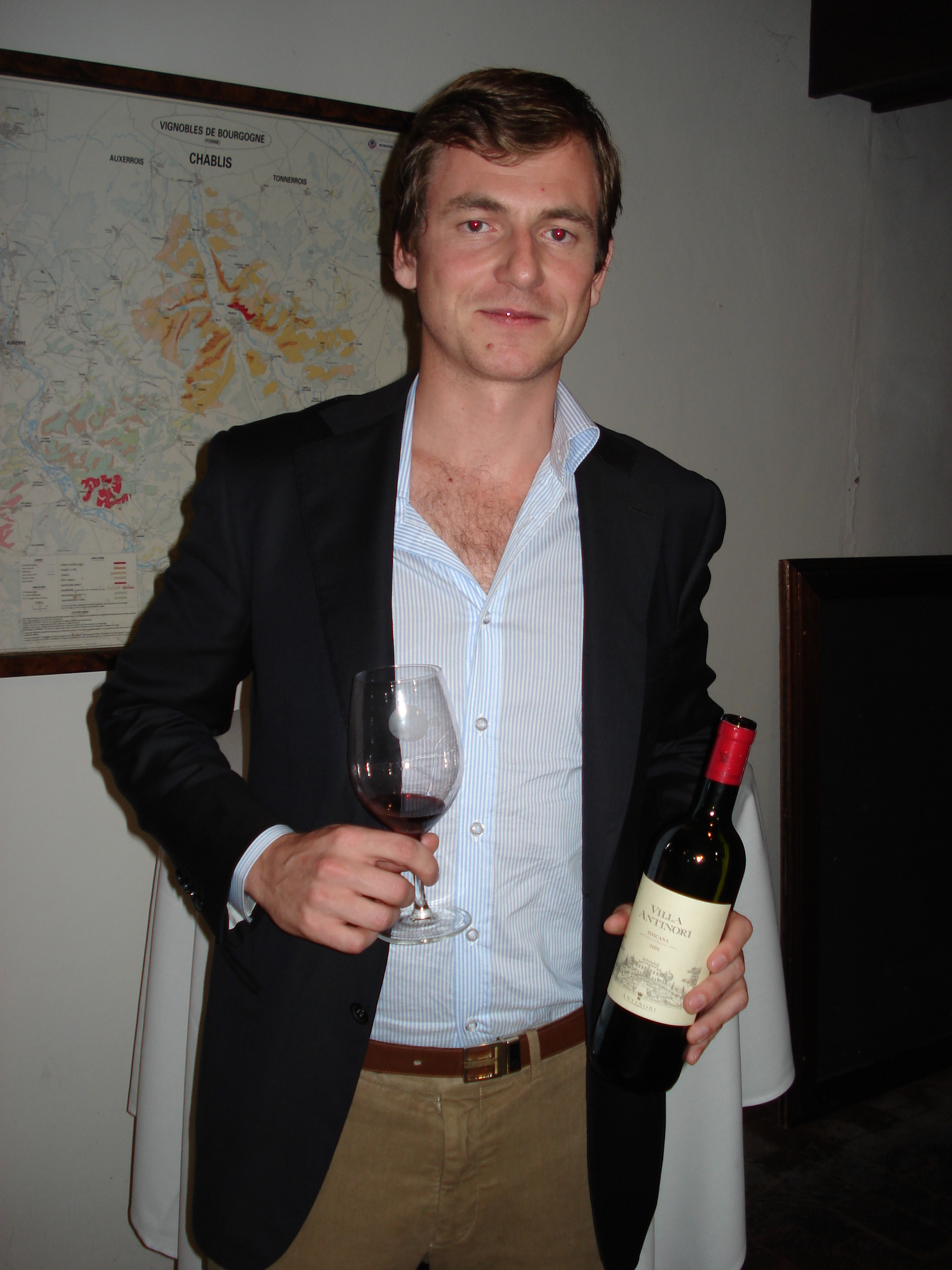
Jacopo of Antinori Estates

To understand more about the wines, Jacopo talked us through the history of Tuscan wines and the birth of the so-called Super Tuscans. Jacopo is the son of a winemaker and the godson of Piero Antinori, who is considered to be one of the four key people who turned the focus of Italian wine from quantity to quality in the 1960s and 1970s. Remember the Chianti bottle wrapped in straw – the best candle holder in the world he said! It was generally a very tannic, acidic, easy-drinking sangiovese, which had to go with food.

Piero, his uncle Niccolo Incisa from Sassicaia, his brother Ludovico Antinori from Ornellaia and friend Angelo Gaja from Piedmont are the four people considered to be the fathers of modern quality wine production in Italy. They introduced new winemaking techniques, clonal selection, and a change in focus towards quality and the ability to age wines, learning from the French where this had long been the focus for the premium end of the market. This had not been the case in Italy where the norm was to produce table wine.

Chianti has always been made predominantly from sangiovese. However, it surprised me to find out that it used to be required for Chianti wines to include white grapes, and it was made in big casks. These wines could not last a long time, and Piero wanted to make better quality wines that would age well. He wanted to get rid of the white grapes, make the wine in barriques, be more selective about the clones he used, and to add other red grapes, such as cabernet sauvignon and created Tignanello in 1971, a blend of sangiovese, cabernet sauvignon and cabernet franc. A few years before, in 1968, he sent his winemaker to assist in the production of Sassicaia, a blend of sangiovese and cabernet sauvignon and one of the most amazing wines in the world in my humble opinion! I tried one recently and was told before tasting that it would be like ‘sex in the glass’. It more than lived up to this! Any wine lover should try this at least once in their lifetime.

Jacopo told us that the name Super Tuscan was coined by the Americans and includes Tignanello, Ornellaia, Solaia and Sassicaia, all produced in Tuscany and not following any rules other than having to be made from grapes typical to the region. They are full-bodied wines (by Italian comparisons – not necessarily by Australian!) and ‘super’ good.

We started our tasting with a very pleasant white called Campogrande Orvieto Classico – a blend of five local white grapes. Though a 2009, the wine was fresh and floral with a mineral character. Tuscany is not known for its white wines – this white is from a town called Orvieto in the neighbouring region of Umbria, a region famous for easy-drinking white wines. It has similarities to Chablis in its mineral soils, producing the mineral characteristic in its wines.

The most awarded white wine (for the Gambero Rosso, Italy’s major wine guide) in Italy is also from this area and is a chardonnay and grechetto called Cervaro. Made in the Chablis style it can easily age for 20 years.

All of the rest of the wines we tried were based on sangiovese, the most produced red grape in Italy. The three main areas in Tuscany for sangiovese are Chianti, Montalcino and Montepulciano. More about these below but a quick note about the wine classification system which is important in understanding these wines.

Classification
Originally there were the DOC, the DOCG and vino de tavola (table wine). The first two categories were essentially linked to appellations and the table wine had far fewer restrictions and was associated with lower quality. There were rules surrounding DOC and DOCG wines and if broken then the wines would only be allowed to be sold as table wine. So for example if cabernet sauvignon was added to sangiovese it could not be called a Chianti, but would have to  be reclassified as a table wine, even if it was so good that the cost was four times as much. The same was true with Tignanello (the first sangiovese/cabernet blend), Ornellaia and Sassicaia – they were costing hundreds of thousands of lira so the government came up with a new category – IGT (meaning Indicazione Geografica Tipica – typical geographical indication).

IGT is not related to an appellation. The grapes just have to come from that region and be typically cultivated in that region, e.g. Tuscany. It is not tasted at all to pass any tests. The table wine category remains – this wine cannot be called IGT because it uses grapes from other regions too. So for example, a wine with malbec cannot be called IGT Toscana because malbec is not typical to that region.

Blending
I was interested to learn that most wines from Tuscany are blends. This is because the dominant grape, sangiovese, is a late ripening grape and it is difficult to pick it perfectly ripe, especially in Chianti because this is the coolest region where it ripens latest. To avoid the rain it needs to be picked, often too acidic and too green, so other grapes are added to give roundness and balance and to counter the acidity of the sangiovese. This is because of the lack of clonal selection in previous years to find clones best suited to this cooler climate.

The regions and rules
As stated above, the three main areas in Tuscany for sangiovese are Chianti, Montalcino and Montepulciano. Here is an overview of regional characteristics and blending rules:

Chianti

  • Due to its high altitude, this is the coolest of the three regions and the latest to ripen.
  • Wines must contain at least 80% sangiovese and any of six red grapes up to 20% (the six include cabernet sauvignon, merlot and syrah). No white grapes are allowed.
  • Wines must be aged for a minimum of one year before sale. It can be released on 1 October of the following year from bottling.

 Montepulciano

  • Located in south-east Tuscany, it is far from the sea but the large Lake Trasimeno helps to keep temperatures warmer in winter and cooler in summer. This helps with ripening so the grapes are more tannic and less acidic than in Chianti.
  • Wines must contain at least 70% sangiovese and any of the six red grapes listed above.
  • Wines must be aged for a minimum of two years before sale.

Montalcino

  • Located closer to the sea and at a lower altitude, sangiovese ripens first in the three regions. The grape skins are thicker here, giving more tannins.
  • These wines must be 100% sangiovese – the grapes always ripen in Montalcino so there is no need for blending.
  • Since these are powerful tannic wines, they must be aged for five years to be released, and six years for the riserva.

Back to the wines we tried…


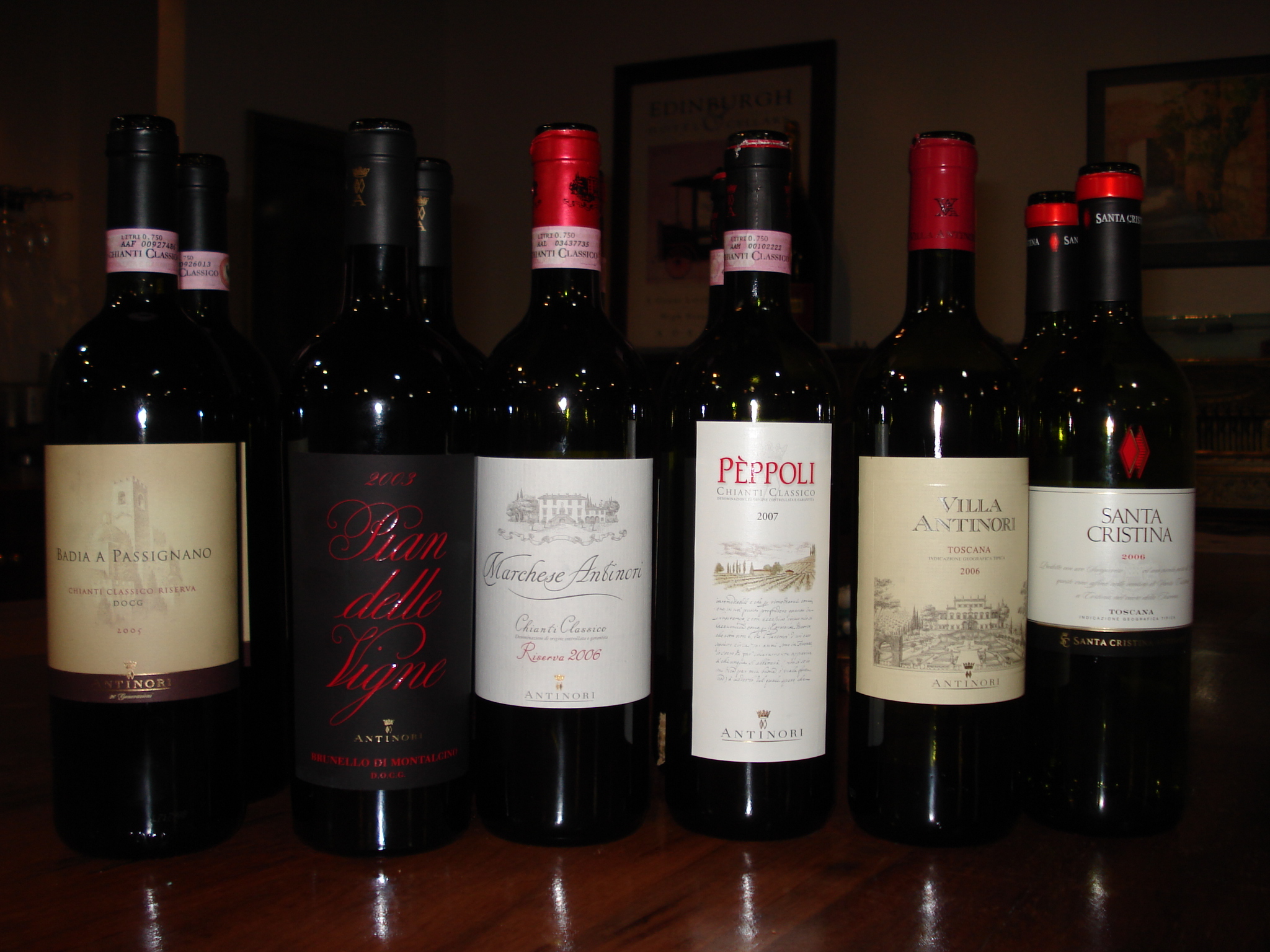
Antinori Estates wines

Jacopo took us through a range of sangiovese-dominated wines:

  • 2006 Santa Cristina Sangiovese (sangiovese 90%, merlot 10%)
  • 2006 Villa Antinori Toscana Rosso (sangiovese 60%, cabernet sauvignon, merlot, syrah)
  • 2007 Peppoli Chianti Classico (sangiovese 90%, merlot and syrah 10% together)
  • 2006 Marchese Antinori Chianti Classico Riserva (sangiovese 90%, cabernet sauvignon 10%)
  • 2005 Badia a Passignano Chianti Classico (sangiovese 100%)
  • 2003 Pian delle Vigne Brunello di Montalcino (sangiovese 100%)

Jacopo talked about these wines, saying in general they are made to go with food, being dry, tannic and savoury. We started with the 2006 Santa Cristina and worked our way down the list (and up in price!). This he called a traditional Tuscan every-day wine. Garnet/cherry red in colour I found it savoury with a cutting acidity and pleasant red berry flavours. The 2006 Villa Antinori Toscana Rosso, which went from being a Chianti Classico Riserva to an IGT in 2001, was a little rounder.

The next three Chianti Classico were all a step up and I would have been happy to have them with or without food. The Peppoli had a mellow mid-palate and soft tannins and is Antinori’s most successful wine in Australia. I found it had a fragrant and complex nose dominated by red fruits and florals, with a touch of ripe berries and mint. The soft palate of pleasing raspberry and spice was long, and the balanced acidity and soft tannins were evident.

The 2006 Marchese Antinori Chianti Classico Riserva had a bit more body and a sweeter flavour. I got purple berries on the nose and palate. An elegant wine, it was all in balance with soft tannins and cleansing acidity.

The 2003 Pian delle Vigne Brunello di Montalcino gave me a ripe nose, and very pleasing savoury, earthy notes and a strong whiff of licorice.

All of the wines were good, my three picks were the Chianti Classicos but I also loved the Brunello – oh heck I couldn’t really pick!

And finally, a couple of interesting snippets…
–  With Ste Michelle Wine Estates, the Antinori family owns Stag’s Leap Estate, one of the leading (and most famous) wineries in Napa Valley, California.
–  For the first 40 years of the 20th century, Antinori supplied wine to the Italian royal family.

Posted in Cabernet sauvignon, European wine, Old World Wine, Sangiovese, Wine varietals and blends | Tagged , , , , , , , , , , , , , , , , , , | 4 Comments

South Australia’s first state cellar door wine festival!


On 25 February 2011, the first ever state cellar door festival was launched in Adelaide. Over 100 wineries attended, each presenting their best wares. It stretched over three days – Friday, Saturday, Sunday, and the perfectly chosen venue was the Adelaide Convention Centre near the railway station in the centre of Adelaide.

The general feel of the wineries and the attendees was that it was a roaring success with over 3,000 tickets sold for this inaugural event, and people were truly interested in the wines and the wineries, not just coming along to see how inebriated they could get – a criticism of some wine events! There was an overwhelmingly friendly and relaxed atmosphere and at every wine stand I went to I was welcomed warmly and shown the wines with enthusiasm and without pressure. I shall certainly attend in 2012 if they organise this again and would encourage wineries to participate and wine lovers to come along and enjoy it.

The $20 ticket included an elegant Riedel glass (RRP $20) which was perfect for the tasting and it entitled you to unlimited tastings. It also included a $5 token to buy a glass of wine – although some wines cost $10 for a glass, as was the one I chose – an Amadio sagrantino – see below. There were also a number of master classes at an extra cost.

I attended for the whole day on the Sunday (7.5 hours!) and did not run out of people to talk to and wines to taste, arriving at 10.30am and leaving as it was closing at 6pm. I barely scratched the surface, visiting a fraction of the stands, although I did my best for the sake of my readers!

The venue was ideal, with plenty of space and a very clear layout. Wineries were organised by key South Australian regions and there were also a few micro-breweries represented. (Full list at the end of this article.)

In addition, the premier sponsor of the event, A+ Australian Wine – Wine Australia, had a large stand with varietals – they were presenting a bottle from each of (most of) the wineries, giving an excellent overview of the whole event. The two clear standouts for me at this stand were Knappstein’s Clare Valley (Watervale) hand-picked 2010 riesling – which had great length, honey characters, strongly varietal and rounded fruit; and a Barossa wine that surprised me – Amadio winery’s 2009 sagrantino – an interesting Italian red variety that gave me tomato leaf, rhubarb and cherry. A pleasing amount of fruit sweetness balanced with modest oak, it was a medium-bodied red wine with a long finish. Fabulous – this is the kind of experience that makes these events memorable.

Looking at the regional stands, the first region I came to was Fleurieu/McLaren Vale. Although I am familiar with most of the wineries there, it is always good to refresh your memory and try their latest releases. I stopped by Serafino, Chapel Hill, Penny’s Hill, d’Arenberg, Dog Ridge, Hugh Hamilton and Vinteloper. There were so many to try that I mainly noted the standouts – purely subjective of course:

Penny’s Hill 2009 Cabernet Sauvignon – lovely fruit, great varietal characters, only $24.

Vinteloper’s ‘Adelo’ (meaning obscure) – a 2010 blend of touriga, shiraz and pinot noir – an obscure blend – but it worked for me!

My pick of Coonawarra was the Raidis Estate winery – I loved all of the wines I tried – the riesling, pinot gris and the cabernet sauvignon, all giving generous yet elegant fruit and all notably varietal. Typifying Coonawarra the cabernet had a gentle hint of eucalypt. The labels were memorable by the goats, signifying the goats that they have at the vineyards eating the grasses and cover crops.

I visited the St Mary’s Wines stand, representing the Limestone Coast and was pleasantly surprised to find some aged reds, particularly a 2001 merlot and 2006 cabernet sauvignon, made in the European, elegant Bordeaux style. The cabernet was just beautiful.

From Langhorne Creek I had to stop by and see Anne and Mac of Cleggett winery – of white cabernet sauvignon fame – I visited their winery recently and wrote the whole story behind their white and bronze cabernet sauvignon grapes (see “White cabernet sauvignon – sampling a world first from South Australia“). They had brought along some bunches of the bronze and white grapes to show people, picked that very morning (pictured).

Adelaide Hills is an area I am very familiar with so I went to a winery I was not familiar with – Coobara, in Birdwood. Their labels have a range of birds on them, making them memorable and attractive. I very much enjoyed their low alcohol 2010 riesling (10.0%) which had a fruity, zingy nose and a slight sweetness on the palate with a clean finish. The pinot gris was also pleasing with a smokiness on the palate, rounded generous fruits and great length.

I also must mention the Paracombe Adelaide Hills 2007 Cabernet Franc – always a good wine.

From Clare Valley a new winery for me was the Good Catholic Girl Wines. The 2007 shiraz was rich and flavoursome. A definite standout.

Neagles Rock presented some lovely Clare Valley offering, with great fruit, especially the sangiovese, a lighter style of red wine.

I had to taste some of the Paulett’s riesling too – always exceptional and did not disappoint.

Last but not least for me after a long day of tasting was the Barossa – I headed to my friends at Barossa Valley Estate – these guys always produce a most excellent shiraz for all ranges in the price spectrum, up to the E&E Black Pepper Shiraz, current release 2006 – an icon of South Australia in my opinion.

I sincerely hope that this event is supported even more strongly in 2012 as it has the potential to be one of the best wine events of the year. The list of wineries who attended is provided below and I have added a few photos to give you a feel for the day.

Cheers!!

Tigs

This slideshow requires JavaScript.

For your reference, this is the list of wineries represented, plus a few SA micro breweries:

ADELAIDE HILLS
Amadio Wines   www.amadiowines.com
Coobara Wines   www.coobarawines.com.au
Golding Wines   www.goldingwines.com.au
Henschke   www.henschke.com
Hermitage Premium Wines   www.hermitagewines.com.au
Howard Vineyard   www.howardvineyard.com
K1 by Geoff Hardy   www.k1.com.au
Kersbrook Hill Wines   www.kersbrookhill.com.au
Longview   www.longviewvineyard.com.au
Nepenthe Wines   www.nepenthe.com.au
One Planet Cellars   www.oneplanetwine.com
Paracombe Wines   www.paracombewines.com
Petaluma’s Bridgewater Mill   www.petaluma.com.au
Protero Wines   www.proterowines.com.au
The Lane Vineyard   www.thelane.com.au
Tomich Wines  www.tomichwines.com
PRODUCER www.bdfarmpariscreek.com.au

BAROSSA VALLEY
Balthazar Barossa   www.balthazarbarossa.com
Barossa Valley Estate   www.bve.com.au
Craneford Wines   www.cranefordwines.com
Domain Day   www.domainday.com.au
God’s Hill Wines   www.godshillwines.com
Gumpara Wines   www.gumpara.blogspot.com
Hart of the Barossa   www.hartofthebarossa.com.au
Hentley Farm Wines   www.hentleyfarm.com.au
Jamabro Wines   www.jamabro.com.au
Liebichwein   www.liebichwein.com.au
Linfield Road Wines   www.linfieldroadwines.com.au
Milhinch Seize the Day Wines   www.seizetheday.net.au
Murray Street Vineyards   www.murraystreet.com.au
Penfolds   www.penfolds.com
Saltram Wine Estate   www.saltramwines.com.au
Schild Estate Wines  www.schildestate.com.au
Smallfry Wines   www.smallfrywines.com.au
Soul Growers   www.soulgrowers.com
St Hallett Wines   www.sthallett.com.au
Tomfoolery Wines   www.tomfoolerywines.com.au
Winter Creek   www.wintercreekwine.com.au
Wolf Blass Wines   www.wolfblass.com

CLARE VALLEY
Annie’s Lane   www.annieslane.com.au
Artwine   www.artwine.com.au
Good Catholic Girl Wines   www.goodcatholicgirl.com.au
Jeanneret Wines   www.jeanneretwines.com
Kilikanoon Wines   www.kilikanoon.com.au
Knappstein Enterprise Winery & Brewery   www.knappstein.com.au
Neagles Rock   www.neaglesrock.com
O’Leary Walker Wines   www.olearywalkerwines.com
Paulett Wines   www.paulettwines.com.au
Reillys Wines   www.reillyswines.com.au
Sevenhill Cellars   www.sevenhill.com.au
Stephen John Wines   www.stephenjohnwines.com
Taylors Wines   www.taylorswines.com.au
Tim Adams Wines   www.timadamswines.com.au
Tim Gramp Wines   www.timgrampwines.com.au

FLEURIEU – McLAREN VALE
Battle of Bosworth Wines www.battleofbosworth.com.au
Cascabel Winery   www.cascabelwinery.com.au
Chapel Hill   www.chapelhillwine.com.au
Conte Estate Wines   www.conteestatewines.com.au
d’Arenberg   www.darenberg.com.au
Dogridge   www.dogridge.com.au
Dowie Doole   www.dowiedoole.com
Halifax   www.halifaxwines.com.au
Hardys Tintara   www.hardys.com.au
Haselgrove  Wines – Modern McLaren Vale   www.haselgrove.com.au
Hugh Hamilton Wines   www.hughhamiltonwines.com.au
J&J Wines   www.jjwines.com.au
Kay Brothers Amery Vineyards   www.kaybrothersamerywines.com
Leconfield – Home of Richard Hamilton Wines   www.leconfieldwines.com
Oxenberry Wines  www.oxenberrywines.com
Paxton   www.paxtonvineyards.com
Penny’s Hill & Mr Riggs Cellars   www.pennyshill.com.au
Rosemount Estate   www.rosemountestate.com.au
Scarpantoni   www.scarpantoniwines.com
Serafino Wines   www.serafinowines.com.au
Ulithorne Wines   www.ulithorne.com.au
Vinteloper Wines   www.vinteloper.com.au
Wirra Wirra Vineyards   www.wirrawirra.com.au
Yangarra Estate Vineyard   www.yangarra.com
Zimmermann Wine    www.zimmermannwine.com

FLEURIEU – LANGHORNE CREEK
Bremerton   www.bremerton.com.au
Cleggett Wines   www.cleggettwines.com.au
Gipsie Jack Wines    www.thewinehouse.com.au
Hearland Wines   www.thewinehouse.com.au
John’s Blend by John Glaetzer   www.thewinehouse.com.au
Kimbolton Wines   www.thewinehouse.com.au
Lake Breeze Wines   www.lakebreeze.com.au
Rusticana Wines   www.rusticanawines.com.au
Step Rd   www.steprd.com

FLEURIEU – SOUTHERN FLEURIEU
Mosquito Hill Wines   www.mosquitohillwines.com.au

LIMESTONE COAST – COONAWARRA
Brand’s Laira Coonawarra   www.mcwilliamswinesgroup.com
DiGiorgio Family Wines   www.digiorgio.com.au
Flint’s of Coonawarra   www.flintsofcoonawarra.com.au
Hollick Wines   www.hollick.com
Leconfield Coonawarra   www.leconfieldwines.com
Penley Estate   www.penley.com.au
Raidis Estate   www.raidis.com.au
Rymill Coonawarra   www.rymill.com.au
Zema Estate – Coonawarra   www.zema.com.au

LIMESTONE COAST – PADTHAWAY
Henry’s Drive Vignerons   www.henrysdrive.com
Morambro Creek   www.morambrocreek.com.au

LIMESTONE COAST – PENOLA
St Mary’s Wines   www.stmaryswines.com

RIVERLAND
919 Wines   www.919wines.com.au
Banrock Station Wine & Wetland Centre   www.banrockstation.com.au
Mirabella Vineyards   www.mirabellavineyards.com
Spook Hill Wines  www.spookhillwines.com

SA Micro Breweries
Brewboys  www.brewboys.com.au
Knappstein Enterprise Winery & Brewery  www.knappstein.com.au
McLaren Vale Beer Company   www.mvbeer.com

Posted in Barossa wine, Cabernet sauvignon, Langhorne Creek wine, McLaren Vale wine, New World wine, Riverland wine, South Australian wine, Syrah/Shiraz, Wine events, Wine news, Wine varietals and blends | Tagged , , , , , , , , , , , | 4 Comments

Pirramimma releases its super premium ACJ – it had better be good – and it is!

When a renowned family-owned winery releases only the second vintage of its super premium wine, named after its founder and pitched at a standard a notch above its already consistently good premium wine range – it had better be good!

Pirramimma winery in McLaren Vale, South Australia, has done just that. One of the oldest family-owned wineries in the region, established in 1892, Pirramimma is known around Australia and overseas for its White Label and Stock’s Hill wine ranges, in particular its White Label Petit Verdot and its White Label Shiraz, both winning numerous awards and acclaim.

Pirramimma 2007 ACJ

The 2007 ACJ is only the second release of this winery’s super premium wine, the first being the 2004. ACJ are the initials of the founder Alexander Campbell Johnston, a Scottish immigrant who established Pirramimma – an Aboriginal term for ‘the moon and the stars’. The winery remains in the hands of the Johnston family, with Geoff and Louise now at the helm.

The 2007 ACJ oozes quality just from the presentation. The simple but elegant and sophisticated look is created using dark purple and gold sparingly, with the family shield moulded out of gold metal. This bottle looks exceptional, almost regal – but what is inside is what matters.

Pouring my first glass, the colour is incredible – deep, dense, dark purple/black. On the nose I immediately got briary berries, coffee, licorice, black cherry, mocha and spice. This is a wine that benefits greatly from decanting – I triple decanted to make sure I had totally woken it from its slumber! Thereafter, the berries were jumping out of the glass. The nose was even more generous the next day after opening – bursting with chocolate-covered black cherries with hints of blackberry and violets, licorice and blackcurrant, and a dusting of subtle cedar.

On the palate this blend is simply magnificent, delivering what the nose promises – not only do you get chocolate-covered black cherries, this is much much more. The chocolate is the darkest, most velvety luxurious, delectable hand-made chocolate beyond even Willy Wonka’s wildest imaginings, and the cherries are dark, purple, plump and juicy, bursting with rich, ripe seductive kirsch jus. Close your eyes and savour the perfection. Soft, enveloping, massaging the tongue, the tannins are fine and elegant, and the generous fruit ripeness gives way gently to a long dry finish. The whole package in perfect balance.

This wine will cellar and develop beautifully over many years. To enjoy it now, triple decant and prepare your senses for a treat. But get in quick – only 500 dozen were produced using Pirramimma’s best quality fruit.

Come and taste this amazing wine at cellar door or order online or over the phone.

Grapes: shiraz 61%, petit verdot 24%, cabernet sauvignon 15%

Alcohol 14.5%
Residual sugar 0.5 g/l
Maturation: 24 months in French oak, 25% new

www.pirramimma.com.au

Tel: 08 8323 8205

Pirramimma Winery
Johnston Road
McLaren Vale
SA 5171

Posted in Cabernet sauvignon, McLaren Vale wine, New World wine, Petit verdot, South Australian wine, Syrah/Shiraz, Wine news, Wine varietals and blends | Tagged , , , , , , , | 2 Comments