Private labels – back to Australia and back to wine

Introduction
Welcome to the fifth and final article in the private label series for Wine2030, a forward-looking wine research network at the University of Adelaide. I have asked questions throughout this series and started to answer some of them – it is up to the reader to take a considered view based on facts and observation and I invite discussion.

Before launching into the discussion around private labels and particularly with respect to wine in Australia, here are some selected private label wine statistics from around the world to whet your appetite:

–        US-based company Costco is the largest retailer of fine wine in the world.

–        Californian private label wine Charles Shaw has sold more than 300 million bottles across the US since 2002.

–        In Australia, Coles and Woolworths control 45 percent of the retail liquor market.

–        In the UK, depending on who you ask, anywhere from one third to one half of the volume of wine sold is own label. In Italy it is over 60 percent. In Australia it is 10 percent and rising.

Private labels in the wine industry – restating the issue
This is the fifth article in a series focusing on the rise of private labels across the world, where private labels are defined as retailer brands, also known as home brands, own brands, buyer’s own brands (BOBs), own labels, store brands, and probably more. I became intrigued by this topic after reading articles and seeing a range of television news items in Australia. Some reported excitement about the arrival of some of the world’s big players in Australia – such as the imminent arrival and spread of companies such as Aldi, Zara, Gap and Costco. Other items painted a bleak and frightening picture, particularly relating to the wine industry, some predicting the demise of the traditional wineries to be replaced by own label wines, or the supermarkets squeezing winery profits and pushing branded products off their shelves, some even referring to the supermarkets as ‘predators’. I wanted to know what the facts were behind this hype.

What I have discovered has surprised me. In Australia there is a great deal of emotion and national pride tied up in the wine industry. This is a good thing to an extent, as anyone who takes pride in their work will produce the best results. However, it must not be combined with a blinkered, myopic or anti-competitive approach to business practice as this will eat away at the industry and weaken one of this country’s current areas of strength.

Whether consumers or the wine industry like it or not, private labels are a fact of business life and are here to stay. The best approach is to understand why they are growing, from a producer and consumer point of view, and how industry can incorporate this marketing phenomenon into their own strategies. I can put it no better than Lincoln and Thomassen (2008):

“Private label is a brand owner’s wake-up call. Wake up to business reality. Wake up to the shopper. Wake up to what your company can potentially do. Wake up to real proactivity. Wake up to an opportunity to put your company back in touch with the rest of the world.” (p.4)

Private labels in the wine industry – examples overseas
Before coming back to specific developments in Australia there are some case studies I consider need to be outlined. The approaches and experiences of these companies are insightful for the discussion of what is happening in Australia.

(1) Two Buck Chuck
Arguably the most high profile and successful of private label wines in the world is the Charles Shaw label. In the US, the California-based Bronco Wine Company buys bulk wine, bottles it under the Charles Shaw label and sells it throughout the US exclusively through Trader Joe’s stores. As stated in Article 3, Trader Joe’s is a US-wide chain selling predominantly private labels and owned by the Albrecht brothers who founded the German-based multinational Aldi, which also concentrates on private labels.

Over 300 million bottles of Charles Shaw wine have been sold since 2002, according to the UK’s BBC series Oz And James’s Big Wine Adventure documenting wine writer Oz Clarke and Top Gear presenter James May travelling around California trying wines. These wines are nicknamed Two Buck Chuck as they sell for as little as $1.99 per bottle in California, and in other states where it is sold it can be a little more at $2.99 to $3.39 (Chuck is a nickname for Charles).

In this programme, both Oz and James were pleasantly surprised by the taste and quality of the wine. In the examples they showed, the marketing was simple, with the wines labelled as Californian merlot, shiraz, cabernet sauvignon, Beaujolais nouveau, chardonnay or sauvignon blanc. On accounts I have read, the wines are not exceptional but also not terrible. On 13 August, 2009, the ABC News channel reported that the chardonnay won top prize at a tasting competition in California: ‘Two Buck Chuck’ Wine Aims for Both Quality and Quantity.

They interviewed the owner Fred Franzia (nephew of wine legend Ernest Gallo), who said “I’m a money maker”. His philosophy is: “We choose to sell good quality wines at $2 a bottle because we think it’s a fair price. We think the other people are charging too much.”

This made me think – he is clearly providing a product that people want to buy. If he can sell it at this price, who is to judge that? Do winemakers or marketers have to be seen as altruistic or master craftsmen, or are they just businessmen like any other?

(2) Costco’s Kirkland Signature
A significant player in fine wines in the US is Costco, the largest retailer of fine wine in the world. It is the third largest retailer in the US and the ninth largest in the world. Founded in Kirkland, Washington state, Costco is the largest membership warehouse club chain in the US (with 55 million members as of September 2009).

Costco also has a massive online presence. Customers are not required to become members to make a purchase online – a 5 percent surcharge is charged to non-members.  As of April 4, 2010, Costco had 567 locations across 40 US states, Puerto Rico, UK, Canada, Mexico, Taiwan, South Korea, Japan and one in Melbourne, Australia, opened in August 2009.

Costco concentrates on selling at low prices and often in bulk. As with Aldi, product presentation at stores is often on the pallets that the products arrive on. It sells a high proportion of private label products, typically under the Kirkland Signature label. The number of wines sold is limited to around 100 and the prices kept down with minimal mark-up. Well known brands of wine are sold (such as McLaren Vale’s d’Arenberg and Alsace’s Hugel) as are the range of Kirkland Signature wines, reviewed on a Costco wine blog. The private label wine is from the US, France, New Zealand, Italy and so on, and clearly labelled as such, with the Kirkland Signature name also clearly displayed.

Costco and the Bronco Wine Company are massive retailers of private label wine based in the US. In the UK, over 80 percent of off-trade wine sales are through supermarkets and around half of off-trade wine sales are private label. Tesco has been pioneering in this, and the other supermarket chains such as Sainsbury, Waitrose, Asda and Marks and Spencer, have all followed this strategy. Marks and Spencer is in fact almost exclusively private label, selling under the St Michael brand, although their private label wine is presented in such a way as to let consumers know who the producers are. These companies aim to build customer loyalty (discussed in Article 4), partly through private labels, and over time have expanded their range and magnitude of products in their private label ranges, including wine.

What about Australia?
The Australian market has similarities and notable differences from what is happening in Europe and the US. Key points I have noted in my research on the Australian market are as follows:

  1. Private labels are still seen as inferior to branded products but this is lessening
  2. Acceptance of private labels in many product ranges is rising
  3. It is happening anyway – private label sales are common and growing across Australia, plus US and European based companies who employ private label strategies are coming to Australia
  4. Major Australian supermarket chains account for a substantial share of national sales of groceries and liquor
  5. The private label trend in wine is underway in Australia
  6. Many in the Australian wine industry and some consumers see this trend as a negative development
  7. Australian companies do not let their customers know that private label wines are their products – unlike overseas

Points 1 to 4
The first four points relate more generally to private labels and are covered in the first four articles in this series and this article will look more closely at the last three points. To recap, with regard to the image of private labels, according to a recent article in the Australia and New Zealand publication Global Food and Wine Magazine, Australia is at a different stage to Europe:

“In Australia’s supermarkets ‘home brand’ products are viewed often as inferior versions of branded produce. But that’s not the case in Europe. There, products in this range – known as ‘private label’ – are often high quality and account for approximately 25 percent of grocery sales.”

However, the Australian market is following trends of increased acceptance. As stated in Article 3, according to researchers IbisWorld, private labels accounted for 23 percent of grocery sales in 2010, and the share is rising. Not only are Australian companies mimicking many of the strategies of successful companies in the US and Europe through the expansion of private label ranges across range of price brackets and across more product categories, but these US and European based multinationals are setting up in Australia so this phenomenon is coming to Australia, like it or not.

In an article in Foodweek entitled ‘Private label ratio soars’, August 2010, IbisWorld says: “private labels are very popular with Australia’s low-income families, accounting for more than 30 percent of their grocery bill. Slowly but surely, Coles, Woolworths and other retailers are converting young single people (5 percent), couples without children (5 percent) and high-income families (15 percent) to private labels, predominantly through in-store promotional campaigns.”

The infrastructure and competitive framework is in place in Australia, with the trio of Woolworths, Coles and Metcash (owner of the IGA chain) sharing 71 percent of the packaged liquor market.

Point 5 The private label trend in wine is underway in Australia
Anyone can see for themselves that the private label trend in wine is established and growing in Australia. Just go into any of the liquor outlets of Woolworths, Coles or IGA and have a look at the bottles.[1] It is not initially clear from the labels that the wine is private label until you know what you are looking for.

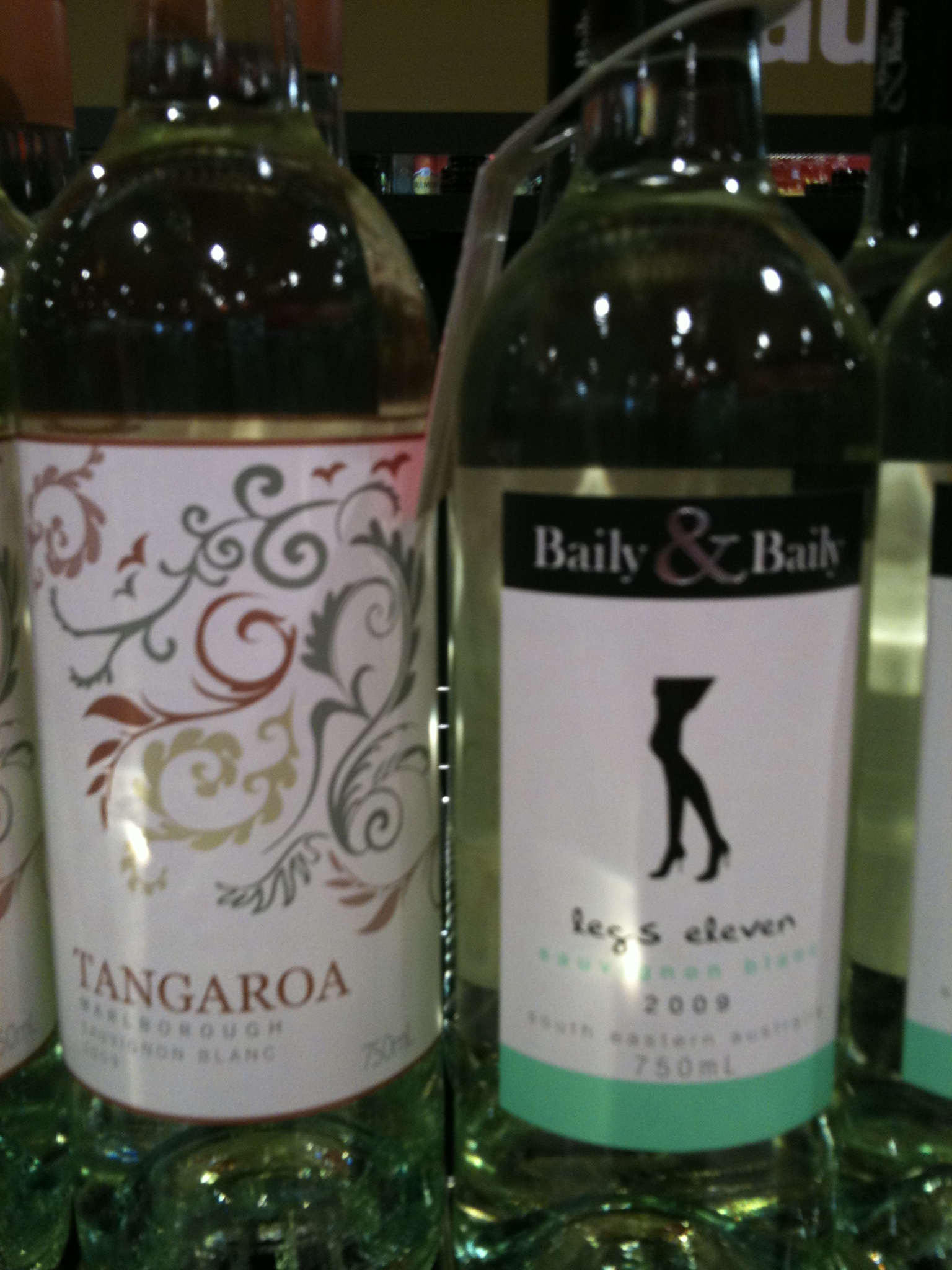
Examples I found in Woolworths were the Crittenden and Co. Range, Baily & Baily, Cow Bombie, Amiri, Tangaroa and many more in the wine range. There are also Dry Dock and Platinum Blonde beers, Mishka vodka and Napoleon 1875 brandy. In Coles, examples of private label wines include Robinsons Marlborough Sauvignon Blanc and Pensilva McLaren Vale Shiraz. Beers include Hammer ‘N’ Tongs, Maxx Blonde, Tasman Bitter and Tasman Gold beers.

The impact is being felt on the branded products. For example, according to independent researcher IbisWorld, in the low-carb beer market, “Since Coles and Woolworths launched their private labels, [Foster’s] Pure Blonde sales had fallen 15 percent”.

IbisWorld predicts that: “Liquor represents the next big growth opportunity for private labels in Australia. IbisWorld forecasts private labels will account for more than 10 percent of the Australian wine market by 2013 and sales of private label beers in this country will double over the next three years.”

Point 6 How the Australian wine industry and consumers regard this trend
Some in the wine industry have stated their opposition to this trend. For example, as cited in Article 1, Stephen Strachan of the Winemakers Federation of Australia (WFA), said (Winemakers worry about proliferation of supermarket home brands, ABC, 9 August 2010) “there’s a risk that ‘home brand’ wine is going to take over the supermarket shelves” and “the low prices of home brands are bad news for grape growers and winemakers”. Furthermore, a story in Australian Wine Business was entitled ‘Predators seizing the day?’ referring to Coles and Woolworths chains in Australia.

I have mentioned my research to a number of people in the wine industry and have found a mixed range of opinions, ranging from indifference to positivity and negativity.

Indifference of course came from those who thought they could ignore the trends and carry on business as always and not be affected. This is clearly not the best approach from a business point of view – this trend is well underway and will continue.

Negativity was dominated by fear of damage to the Australian winemaking industry. The reactions on many occasions were vitriolic. Main points were:

  • Private labels will cause wine prices to be cut, thereby damaging the rest of the wine industry.
  • Supermarkets reduce shelf space for branded products in favour of their own.
  • It was assumed that the quality of private label wines would be relatively poor.
  • People in the industry were largely unaware that this was an established phenomenon across Europe and the US – all the more reason to provide this range of articles to facilitate an informed debate.

Positivity came from those who could see opportunities in these trends. The main views in this vein were:

  • Private label wines have to source wine from somewhere – they will therefore be providing a market for grapegrowers and winemakers. In a period of serious glut in the wine market this will save many businesses and benefit communities.
  • Increased competition is a good thing.
  • Those wineries with a quality product, a sound business model and effective marketing will prosper whatever the competitive environment.
  • The private label phenomenon overseas is already benefitting some Australian wineries as they send their wine to be sold as private label wine in the US and Europe. This is an ongoing opportunity for the Australian winemaking industry.

With regard to consumers, there was a lot of confusion and even less awareness of this phenomenon overseas and within Australia. The overall response was reticence as they shied away from the private label wines once they knew which they were. With the supermarkets regularly portrayed in the Australian media as oligopolistic, wielding strong market powers at the expense of both consumers and suppliers, I found that the general view was that this additional market share was not welcomed.

On discovering that some of what they thought were winery brands were in fact private label wines, there was anger – predominantly at feeling as if they had been duped. So despite the growing acceptance of private labels in Australia for grocery and other consumer items, wine seems at first sight that it may be an exception to this trend. However, is it just that new trends are usually greeted with scepticism and even a little fear?

Woolworths CEO Michael Luscombe has stated in a Sydney Morning Herald article entitled ‘Now it’s Woolworths the wine’ that consumers will warm to private labels in wine, as has happened overseas. The trend will continue he says.

“It’s no different to grocery or anything else that we are in,” said Mr Luscombe. “Consumer electronics, general merchandising, this is a trend that is happening worldwide. In fact, it’s very much behind the world trend in Australia, so there is a lot more of it to come I’m afraid.”

Point 7 Australian companies do not let their customers know that private label wines are their products – unlike overseas
As I have learned more about the trends overseas and the reasoning and economics behind the proliferation of private labels, it has raised a question regarding the approach taken by the Australian supermarkets with regards to wine (and other liquor). As discussed in Article 4, one of the key drivers in selling private labels is to build consumer loyalty. Once a consumer trusts a brand they are more likely to buy it next time they shop. In the US and Europe this rationale is clear with wine as well as groceries. The UK-based Tesco, for example, has applied this strategy successfully to wine, building its range of private labels in terms of the numbers of wines with Tesco branding, and also entering into the full quality (and price) range. Customers try a cheaper private label wine, find they like it and are then confident enough to try the premium ranges, feeling that they can trust the Tesco brand.

In Australia, Coles, Woolworths and IGA have followed this strategy for groceries and continue to expand their ranges in terms of types of products covered and the quality of the products, offering more and more complex portfolios along the lines of Tesco. However, for wine they have chosen a different strategy.

The private labels wines in these stores are given labels which are registered and owned by the stores but the name of the store does not appear anywhere on the label. Therefore, the customer is not aware that the product is a private label product. For example, Tangaroa is one of Woolworths’ private labels. It simply says Tangaroa, Marlborough, New Zealand on the label and on the back says ‘New Zealand wine bottled in Australia’. The same is true of the other private label wines I looked at.

Time to reconsider this issue with a fresh and informed mind
The reality is that Australia is seeing a growing share of its wine market being taken up by private labels, following the trend already well underway overseas. Coles and Woolworths are the biggest drivers of this trend in Australia. The key difference in their approach is the decision to keep their branding off the bottles. This defies the logic of using private labels to build and retain customer loyalty.

I have asked a lot of questions throughout this series and am hoping to provoke discussion. Bringing a few of these points again to the fore here:

  • Is there anything wrong with retailers following a private label strategy for wine?
  • Why are Australian retailers not making it clear which of the wines they sell are private labels?
  • Should a customer expect to have this information?
  • Should the Australian wine industry see this development as a threat or opportunity? Who will benefit and who will lose?
  • Do private labels decrease choice by limiting competition or increase choice by increasing competition?
  • Do consumers ultimately benefit from greater choice and reduced prices?
  • Is quality necessarily going to fall? (This has not been the experience in Europe and the US.)
  • Is Australia a sufficiently different market to expect different outcomes than are being seen overseas?

Why is wine seen as different?
When a supermarket offers us cheaper bread, pasta or milk of comparable quality to a branded product are we upset or perturbed by this because of our loyalty to the branded products? We are pleased to see competition and everyone benefits except the least competitive of the branded product producers who may not be able to compete. This is just Darwinian survival of the fittest. Do we want more expensive brands? No. Then why is wine different? Because we are passionate about wine in this country is probably the main answer. Is there room in the market for both private label and branded wine?

A final word…
My research has thrown up a range of misconceptions and fears about the rise of the private label, and has also enlightened me about its sheer success and reach. This is a huge and complex topic of which I am scratching the surface. A great many PhD theses could arise from this research if anyone wanted to get their teeth into it. I hope I am igniting people’s interest in the topic, dispelling some myths, and inviting thought and discussion.

Other articles in this series:

Article 1: Private labels – what’s the problem? Is there a problem? What about wine?

Article 2: Private labels – what are they?

Article 3: The evolution of selected private label companies and complex portfolios

Article 4: The key to success – building and retaining customer loyalty

References:

Keith Lincoln and Lars Thomassen, “Private label: turning the retail brand threat into your biggest opportunity”, Kogan Page, 2008.


[1] Woolworths liquor stores include BWS, Dan Murphy’s, Woolworths Liquor. Coles liquor stores include First Choice, Liquorland and Vintage Cellars. IGA liquor stores are called IGA Liquor.
Posted in New World wine, NZ wine, Private labels, UK wine, Wine news | Tagged , , , , , , , , , , , , , , , , , , , | 9 Comments

The key to success – building and retaining customer loyalty

“Private label has existed in Europe since the beginning of the 19th century. But it wasn’t until the 1970s when Sainsbury penetrated the European market that private label became an important part of grocery retailing. As in Australia, private label began as a cheap alternative. However, it now has products ranging from basic to exclusive.”

This quote from the Australian and New Zealand publication Global Food and Wine Magazine, 10 July 2009, sums up the discussion so far. Private labels have been around for a long time but the surge has been in the last few decades across Europe and the US and Australia is catching up. The private label is a multifaceted beast, which must be respected and understood, and accepted as part of modern day business, because it is here to stay. Private labels have a virtually 100 percent penetration in European and other developed economies. “In short, in essence nearly everybody now buys private labels” (Lincoln and Thomassen, 2008, p.14)

While the success of the diverse range of companies benefiting from the use of private labels can be attributed to an extensive list of business tactics and innovations, what has become clear to me during this research for the University of Adelaide’s Wine2030 network is that the focus on what the customer wants is key, not just to attract new customers but to retain their custom – in other words, building and retaining customer loyalty.

Customer loyalty – the key to growth and longevity
The overview of the four highly successful multinational retailers profiled in the previous article in this series – Tesco, Aldi, Walmart and IKEA – shows how they all have one thing in common and central to their success to date and to their ongoing expansion and appeal – customer loyalty. I have summarised eight areas which have contributed to this success.

(1)    A consistent image:
What is common to all of the featured companies is that they have put out a constant and clear message of what their company is about and what the customers can expect from them. The slogans that the companies use are an important part of the message to consumers.

Examples:
–        Aldi – “Top quality at incredibly low prices”
–        Tesco – “Every little helps”
–        Walmart – “Save Money Live Better”
–        IKEA – “Love your home”

(2)    Cost cutting and passing savings onto consumers:
All four of the companies I have profiled emphasise that they cut costs where possible and pass the savings onto their customers. Private labels are seen as part of the package for each company. Some of these companies also emphasise making substantial efficiency savings through selling a limited number of product lines, with some cutting out a number of costs altogether, and/or making efficiency savings in the whole product sourcing and transportation chain, and so on. The companies have different strategies of cutting costs, according to their individual approach, for example, Aldi concentrates on a limited range of products while Tesco and Walmart have a much larger range and are aiming for a different kind of marketing.

Examples:
–        All have private labels – Aldi sells around 95 percent private labels, IKEA is a private label retailer. Through ever more complex portfolios, Tesco and Walmart have been rapidly expanding their private label ranges to account for a significant and growing share of their sales.
–        Cutting out a number of costs altogether, such as IKEA with the customers assembling their own furniture.
–        Having limited product lines helps to cut costs for Aldi, with only around 700 SKUs.
–        Aldi’s costs (staff, logistics, overheads, marketing, etc.) from procurement of its products to retail are half that of traditional supermarkets.

(3)    Appeal to all socioeconomic groups:
The cost cutting and assurance of a quality product is something that appeals not only to people on a lower income but to people across all income levels and backgrounds. A customer wants a good deal whatever their personal circumstances. A 2002 survey in Germany by market researchers Forsa found that a large proportion of workers across the four main employment categories shopped at Aldi: blue-collar 95 percent, white-collar 88 percent, public servants 84 percent and self-employed 80 percent.

This wide-ranging appeal goes hand in hand with the trend towards complex portfolios, which has in turn been enabled through the increasing acceptance of private labels (as discussed below). Alongside providing the retail outlet for a wide range of manufactured brands, Tesco and Walmart have successfully introduced own label products across all price levels to compete with the budget end of the branded market right through to selling premium own brands.  They are combining price-based, category-based and benefit-based market segmentation to produce successful and complex portfolios which appeal to all types of consumer.

Example:
Tesco has three main ranges (a good, better, best range architecture): Tesco Finest premium range of products; budget Value range; and an intermediate Tesco range. Tesco has an ever-widening range of products, not only groceries but finance products, cell phone services, petrol stations, electronics, and more (see Article 3), and it reaches its customers through a variety of retail formats in all types of location – city centre, rural centres, out of town centres, online sales, and so on. This complexity means that the whole spectrum of consumers are catered for and Tesco’s market reach is maximised.


(4)    Acceptance of private labels:
No longer regarded only as cheap, generic alternatives, stores’ own brands are winning recognition in their own right. The acceptance of private labels is almost ubiquitous. Buying private labels is seen as ‘smart shopping’ and attracts across all socioeconomic groups. Lower income people may need to buy private labels, but better-off people also choose to because they like good value too. Manufactured brand loyalty is falling, not because there is any evidence that people are less loyal overall, but because they are becoming loyal to store brands.

A recent survey of own brand groceries in Australia by consumer group Choice was reported in The Australian on 13 September 2010 in an article entitled ‘Home brands lose their stigma’. In the study Choice compared the private labels of Coles SmartBuy and Woolworths Home Brand with manufacturers labels and “found that the cheaper store brands often match leading labels for taste and nutritional value”. Furthermore, there were savings to be had: “The survey found that a basket of 30 premium brand items cost $125.48, almost double the $63.51 for the same basket of store brand products.” Private labels are said to account for 23 percent of Australia’s $70 billion grocery market, based on research by independent researcher IbisWorld, which expects this share to reach 30 percent in five years.

Examples:
–        In the UK private labels account for 41 percent of grocery sales, and the US has a similar penetration.
–        Across Europe, the shares are 36 percent in Belgium, 31 percent in Germany, and France and Spain are not far behind.
–        In the UK, depending on who you ask, anywhere from one third to one half of the volume of wine sold is own label. In Australia it is 10 percent.

(5)    Product endorsements and awards for private labels:
The quality of private label products has been proven in the product endorsements and awards won by these products against competitors. As noted in the previous point about acceptance, in Australia, the consumer group Choice has made favourable comparisons in terms of quality and price. This is independent endorsement for the private labels. There have also been studies showing how consumers benefit from lower costs. A 2005 Washington Post story reported that “Wal-Mart’s discounting on food alone boosts the welfare of American shoppers by at least $50 billion per year.” A study in 2005 at Massachusetts Institute of Technology measured the effect on consumer welfare and found that the poorest segment of the population benefits the most from the existence of discount retailers.

These companies also promote the quality and low cost of their own products. For example, on its UK website, www.uk.aldi.com, Aldi provides a list of product endorsements. Aldi also guarantees every product in its store which is a clear demonstration of confidence in its own products. Asda (Walmart’s UK chain) provides endorsements in its wine section from wine critics.

Some examples of awards for private label wines are provided below.

Examples:
–        Waitrose 2002 Vintage Champagne made by P&C Heidseick of Champagne wins a gold medal at 2010 International Wine and Spirit Competition (IWSC), London.
–        Asda Cava Rosado NV wins silver (best in class) at 2010 IWSC for its rosé, made by Jaume Serra of Spain.
–        Tesco Premier Cru Champagne, costing less than £15 a bottle is named the best non-vintage champagne at the 2005 Christmas wine Oscars in UK, beating French Grand Marques such as Lanson and Taittinger.
–        Waitrose Reserve Shiraz 2008 made by St Hallett Wines is named Great Value Champion Red at the UK’s 2010 International Wine Challenge (IWC).
–        Marks & Spencer Puligny Montrachet 1er Cru Les Chalumeaux 2007, Jean Pascal & Fils, is named Champion White Wine at 2010 IWC.

(6)    Earning respect:
In addition to product endorsements and awards, and promotion through independent research such as the Choice and Forsa reports in point (5), consumer respect can be earned through promotion of the image and actions of the company itself.

Examples:
–        Aldi earned consumer loyalty when the euro was introduced in 2003. It was widely believed that many retailers had used the currency switch to put prices up. Aldi displayed clear listings of prices before and after for several months and did not increase prices in Euros versus the national currency.
–        Aldi Australia says on its website that it is “the first grocery retailer to achieve the prestigious ecoBiz accreditation”.
–        IKEA emphasises its involvement in environmental and efficiency initiatives and its contribution to social programmes – the IKEA Social Initiative which it says on the website has helped 100 million children.
–        Walmart promotes its research and programmes to be environmentally friendly cut costs. In 2009, it announced plans to develop a worldwide sustainable product index.

(7)    Innovation:
Part of the building of consumer loyalty has been through ongoing innovation in all areas of business. This is manifested in a number of ways, such as entering into joint ventures with other companies; increasing product and service ranges; cutting costs further through various measures; adapting advertising, promotions and the messages sent out to consumers (which includes changing company slogans); and in developing private label lines. These areas of innovation are covered in Article 3. Some examples are cited here.

Examples:
–        The whole combined approach of IKEA is unique – selling products that customers must assemble themselves and passing on cost savings; sending them round a one-way system in the store; providing childminding services and cheap breakfast.
–        Aldi has employed a number of original cost-cutting measures (limited number of SKUs; minimal staff; selling direct from pallets; coin-operated trolleys; no shopping bags; only accepting cash, etc.) and passes the costs onto consumers. This is the main feature for which Aldi is recognised.
–        Tesco was one of the first supermarkets to sell its goods online.
–        Tesco’s Clubcard (discussed below) was hugely innovative and instrumental in Tesco becoming the largest grocery retailer in the UK.
–        Walmart created its own electricity company, Texas Retail Energy, to power its own stores at wholesale power prices, saving millions of dollars.
–        Joint ventures have enabled companies to sell products with the kudos of the partner, such as Tesco linking with Samsung in South Korea and Waitrose selling St Hallett shiraz from the Barossa.
–        The ongoing increasing range of private labels, and the growing complexity (and success) of private label portfolios reflects ongoing innovation by these companies.

(8)    Loyalty schemes:
Many of the successful retail companies have loyalty cards. Tesco was a trailblazer in this area, introducing its Clubcard in 1995 and making such effective use of the information it could access that it was instrumental in propelling Tesco to becoming the largest grocery retailer in the UK, passing Sainsbury.

IKEA has launched a loyalty card that is free of charge and can be used for discounts on selected products. In Australia, loyalty cards are increasingly common. Woolworths has its Everyday Rewards loyalty card; Coles has not yet introduced one, but is part of the Fly Buys scheme. Looking through my wallet I realised I had accumulated a range of cards from pharmacies – Priceline and Better Health Pharmacies; Miller’s clothing chain; Just Jeans clothing; Athlete’s Foot; and some local hotels and cafés.

Example:
Loyalty cards are a simple tool that have a number of benefits which all lead to the success of the company. Looking at Tesco as the example, Tesco employed the services of the company dunnhumby to establish its Clubcard. Customers collect points on purchases at the stores and through using the Tesco credit card and other Tesco services, and can redeem them for products in-store or for a range of Clubcard deals or for Airmiles.

Through using their Clubcards, transaction data are gathered for the 13 million people (and 50 percent of UK households) on the Tesco Clubcard database. The value in this information is that it reveals what people actually do, in terms of their purchasing decisions and habits – this has an advantage over focus groups in understanding the behaviour of customers, which can only assess what people say they would do. As it states on the dunnhumby website:

“When we know what, how and why they buy, we can work out who our clients’ best customers are and where their biggest opportunities lie.”

The ongoing analysis of the data enables companies to better target promotions and customer communications; design product ranges and new products; set prices and plan store space. They can quickly identify trends as they emerge and target marketing accordingly. They can also measure consumption patterns before, during and after marketing campaigns. This has many advantages, including saving on marketing costs as the campaigns can be more targeted and designed to reach those most likely to respond. As Edwina Dunn states:

“The more targeted the offer, the fewer gimmicks you need to sell it. It will sell itself because it is what people want.”

To conclude:
This shortlist of strategies that assist in building and maintaining customer loyalty is not exhaustive but it does add another layer to our understanding of how these large companies have been so remarkably successful and the role that private labels has at the centre. This is all key to the discussion I would like to initiate about the rise of private labels in Australia.

Having set the scene in the first four articles, with regard to the rise and the appeal of private labels, and examples around the world of private label market penetration, the next article in this series takes us back to the Australian market and focuses in on trends affecting the Australian wine market in particular.  Some questions that occurred to me are:

  • Should some members of the wine industry be worried, concerned or critical of private labels becoming a factor in the wine market, or should they be responding to a new challenge as the  marketplace embraces new trends?
  • Should consumers be loyal to wineries – does buying private labels indicate a loss of loyalty – or a change in the nature of loyalty?
  • Will these trends reduce or increase choice for consumers?
  • Has the recent rise in private labels been a positive step for the Australian wine industry in finding another way to market part of the oversupply?
  • Should retailers be concerned about their behaviour on the wine industry or is it just business at work? Retailers do not owe wineries a living after all. Is this not just a case of the free market working, and the matching of supply and demand?

I would very much like to hear from interested parties, whatever your viewpoint.

In case anyone is in any doubt of the power of the private label, I am closing this article with some interesting statistics:

  • Asda is THE biggest clothing retailer in Britain.
  • Each week, about 100 million customers, nearly one-third of the US population, visit Walmart’s US stores.
  • IKEA is the world’s largest furniture retailer.
  • More copies of the IKEA catalogue are printed each year than the Bible.
  • Tesco plc is the largest grocery retailer in the UK and the third largest retailer in the world measured by revenues and the second largest measured by profits.
  • Aldi was the third most respected corporate brand in Germany behind electronics giant Siemens and automotive manufacturer BMW in 2004 (reference: Aldi: The Next Wal-Mart? 26 April 2004, Business Week, pp.20-23)
  • In Australia, Coles, Woolworths and Metcash (which owns the IGA retail chain) between them share 62 percent of the packaged (as opposed to fresh) grocery sector and 71 percent of the packaged liquor market.  They are currently targeting the fresh food market where their share is lower at around 49 percent.

Other articles in this series:

Article 1: Private labels – what’s the problem? Is there a problem? What about wine?

Article 2: Private labels – what are they?

Article 3: The evolution of selected private label companies and complex portfolios

Article 5: Private labels – back to Australia and back to wine

References:

Keith Lincoln and Lars Thomassen, ‘Private label: turning the retail brand threat into your biggest opportunity’, Kogan Page, 2008.

Posted in New World wine, NZ wine, Private labels, UK wine, Wine news | Tagged , , , , , , , , , , , , , , , | 5 Comments

Adversity begets generosity: The Australian wine community pulls together for 2011 flood relief efforts

I am proud to be a part of the Australian wine industry – a nation-wide yet close-knit community of hard-working, honest and skilled individuals with a passion for a great world-renowned product. This month, in the face of Australia’s worst flooding on record, I am increasingly impressed and humbled by the openness, generosity and compassionate spirit of this community. This article summarises key fundraising efforts and provides links so that people can help and also see who is contributing.

Unprecedented devastation and loss
The horrific and distressing scenes confronting Australians during January 2011 from the floods across Queensland, NSW and Victoria have shocked us all and reminded us how vulnerable we are against the elements. The death toll in Queensland has passed 20 and three quarters of Queensland has been declared a disaster zone. The devastation is unprecedented and the damage is ongoing. The cleanup and fallout will run into months, even years.

Economists predict that losses and damage to property, infrastructure, crops, mining, businesses and more, will shave at least 1% off the national GDP, with costs expected to spiral to several billion dollars.

While the economic loss is devastating, the sadness and shock impacting upon so many people and the repeated testing of the human spirit is what has hit most Australians the hardest. I know I have felt sick to my stomach and been reduced to tears several times watching the terrible events unfold on the television and internet. It brought to mind the recent disasters of the scale of 9/11 and the Boxing Day tsunami – but this was so much closer to home.

Everyone with an ounce of humanity has wanted to help, across Australia and overseas. Thousands have pitched in with practical help in the rescue and recovery efforts and then in the mammoth clean-up task which will continue for months. Many millions of dollars were raised very quickly across Australia through personal and business donations. People have opened up their homes to those displaced and donations are being made of practical and vital items, like food and clothes. There are fundraising events of all kinds – concerts, comedy events, dinners, sporting events, and ongoing collections at shops, pubs, in the street, online, and many many more. I would find it hard to believe (or condone) if anyone has not done something to help.

It is also a time when we can appreciate the usefulness and practicality of social media in supporting those in need and linking people in all locations and walks of life to coordinate the laudable responses we are seeing.

Inspiring wine industry initiatives
I noticed the growing buzz around Twitter and Facebook as the nation’s wine industry began pulling together to help flood victims. These are just a few of the initiatives I came across.

Australian Wine Trade Flood Relief Raffle
The first example I noticed is being organised by the Brisbane-based wine writer Tyson Stelzer, a name well-known to the wine industry. He has set up the Australian Wine Trade Flood Relief Raffle with colleague Mark Folker. I read about it first in Decanter.com, on 13 January 2011, the day after the appeal was launched: Queensland: wine industry rallies round flood victims. Already multinational drinks company Foster’s had donated $500,000 and offers had started from wineries.

Stelzer came up with the idea saying “There are so many people in the Australian wine industry who have contacted me to say they want to do something to alleviate the situation in Queensland. We have close family and friends that have been affected and now is the time to rally the industry.”

The appeal asks for assistance from people from all parts of the wine industry and the public to support the cause. From winemakers, importers and distributors: “We would appreciate donations of raffle prizes. Perhaps a case of wine or two, a special bottle, a membership or event ticket?” From retailers “We would like to ask for your help to sell tickets.” Freight companies were asked to assist in delivery and media to spread the word. The raffle tickets were on sale from 4 February until 4 March for $30 each. The website http://www.winefloodrelief.com.au/ showed where to buy tickets, the list of contributors and the incredible list of prizes.

It is humbling to look at the immense list of contributors to this initiative, accompanied by heartening messages of support. Furthermore, one of the first wineries to donate was Kaeserberg Vineyard in the Lockyer Valley. Jason Kaeser writes: “I had a small vineyard and winery on the bank of Lockyer Creek until the flood took it all yesterday. My wife and I are absolutely heartbroken but so grateful that we just made it out alive with our three dogs.” He goes on to say “I would like to donate a total of 4 dozen bottles of wines. I will be contacting my suppliers and friends to support this as well.”

In just a few weeks, over 400 companies from all over Australia pledged donations of wine, memberships, tours, books, dinners, tickets to events and more. I encourage people to look through the list provided on the Australian Wine Trade Flood Relief Raffle website and read the comments accompanying the pledges. It restores your faith in humanity.

The final amount raised was $276,848.90 of which 70% was donated to the Queensland Premier’s Disaster Relief Appeal and 30% to the Red Cross Victoria Flood Relief Appeal. Expenses amounted to just 1.3% of the funds raised.

Thanks go to Tyson and Mark, plus VisitVineyards.com for their partnership in running this project and to KDJM Communications for a PR campaign that reached a potential audience in excess of five million. Huge thanks must go to the wineries, retailers and couriers who have participated in this cause.

Just some of the wineries donating are (in no particular order):

Kaeserberg Vineyard, Majella, Alkoomi, Mitolo, Tim Adams, Chapel Hill, O’Leary Walker, Teusner, Elderton, Casa Freschi, Hanging Rock, Geoff Merrill, Sylvan Springs, Cape Mentelle, Irvine, Kellermeister, Angove, Shingleback, Hidden Creek, Hahndorf Hill, Forester Estate, Watershed, Symphony Hill, Howard Vineyard, Hollick, Cullen, Taylors, Gilberts, Koltz, Tyrells, Torbreck, Jasper Hill, Spinifex, John Duval, Were Estate, Chateau Tanunda, Cumulus, Eldridge, Shaw and Smith, Currency Creek, Lakes Folly, Paradigm Hill, Zema, Rockbare, Paringa Estate, Pauletts, Tamar Ridge, Mount Mary, Wirra Wirra, Voyager Estate, Primo Estate, Wild Duck Creek Estate, Capel Vale, Chandon, Blue Poles, Grosset, First Drop Wines, Giaconda, Ulithorne, Margan, Hentley Farm, Sirromet, Lucas Estate, Kirrihill, Leconfield, Nugan Estate, Arrivo, Ballast Stone, Kay Brothers, Katnook Estate, Rockford, Peter Lehmann, Sevenhill, Blue Pyrenees, Vasse Felix, and many more…

The Great Aussie Wine-athon
Simon Holt of Winery2u.com has organised The Great Aussie Wine-athon, with 30 wineries from NSW and Victoria providing wine to sell, from which up to $200 will be donated to the Queensland Flood Appeal for each case bought from the site until January 31. Deals are shown on the website.

Participating wineries include: Di Lusso Estate, Miramar, Marist Brothers, Silos Estate, Mount Burrumboot Estate, Burnbrae, Mount Broke, Belgravia, Bidgeebong, Rosby, McKellar Ridge and Orange Mountain.

Victorian Restaurants Unite
Victoria’s restaurant industry has got together to host a series of fundraising events on Australia Day, 26 January 2011, at a fixed price for the consumer, preferably using produce donated by food and wine suppliers and the labour of volunteering staff.  Each participating restaurant will donate all or part of their takings on Australia Day to the relief fund, with the exact percentage donated listed on the website. Victorian wineries Dexter Wines and Tellurian Wines have pledged support.

Canberra Wines Fundraising Dinner
The Canberra wine region is helping flood victims in Queensland. Led by Michael Tabart, the ACT Wine Industry Network has organised a dinner and auction at La Scala Italian Restaurant on 3 February. Canberra District wineries providing wine for the event include Clonakilla, Eden Road, Little Bridge, Lambert, Lerida Estate, McKellar Ridge, Barton Estate, Yarrh, Gundog, Domaine Rogha Crois, Four Winds, Affleck, Yass Valley, Shepherds Run, Jeir Creek, Dionysus, Poacher’s Pantry and Wily Trout, Tallagandra Hill, Koonaburra, Pankhurst Wines and Lark Hill. Details can be found at the Canberra District Wines website.

Charity With Wine
The online wine site Charity With Wine is donating $40 per dozen to the Queensland flood relief.

And there’s more!
The examples provided are far from an exhaustive list. I am also aware of wineries providing wine to retailers and donating those proceeds to the flood relief appeal, and not looking to publicise this fact. I came across a number of wine dinners being held with ticket proceeds going to the flood relief. For South Australia where I live there is a dedicated web page providing details about South Australia’s flood relief efforts, of all magnitudes, to which wineries and wine retailers are often contributors. I assume all states and territories will have something similar.

All of this is on top of donations to the main funds organised by State, Federal and Commonwealth governments.

A last word…
This will be the toughest period in many people’s lives. Yet adversity begets generosity. This is a time to be proud of the Australian wine industry.

Posted in Barossa wine, Langhorne Creek wine, McLaren Vale wine, New World wine, Riverland wine, Social media, South Australian wine, Wine news | Tagged , , , , , , , , , | 1 Comment

Winemaking, viticulture and wine appreciation courses for adults in Adelaide

Shiraz grapes

Hamilton Secondary College offers the unique combination of Adelaide-based adult education courses in wine appreciation, winemaking and viticulture, in a sociable, inclusive and hands-on environment.

Pressing the shiraz

Whether you are looking for something fun and different to learn, have a passion for wine, or have ambitions to work in the wine industry, these courses can fulfil all of these requirements. Additional benefits are the high standard of teaching, the possibility (but no obligation) to gain qualifications, low fees, and attendance times that can fit easily around our working lives. For those wishing to become involved in the wine industry, there are networking benefits as you are introduced to key established players in the South Australian wine industry.

Three related courses offered are:

  • Foundation Winemaking/Winemaking for Beginners
  • Certificate 1 in Food Processing (Wine) [a VET course]
  • Wine Appreciation

The venue is Hamilton Secondary College in the Adelaide suburb of Mitchell Park (contact details at the end of this article). The tutors are: Strat Koultras, a teacher at the college and wine passionado, who through his dedication has established working vineyards and the small-scale Sturt Creek Estate winery and bottling facility on the college campus; and David Crossman who teaches the wine appreciation course.

General information about the courses and enrolling may be found at the Hamilton Secondary College website.

Watch a short clip showcasing the Foundation Winemaking course.

Course overviews:

Foundation Winemaking/Winemaking for Beginners

  • The course covers grape varieties, winemaking, the chemistry of wine, and wine labelling and marketing, and wine regions of Australia.
  • A science-based course designed for adults interested in making wine (with little or no prior knowledge).
  • Incorporates both theory and practical components with hands-on experience.
  • Some physical work with some flexible hours.
  • Lasts between one semester and one year, evenings and some weekends.

Certificate 1 in Food Processing (Wine)

  • A Vocational Education Training (VET) approved course leading to the Certificate 1. This qualification is part of the Food Processing Industry Training Package, Wine stream.
  • Available for the first time in 2011, starting February.
  • Emphasis is on practical experience and will require industry placement or employment.
  • Students will study at the college, work in vineyards during pruning season and undertake tasks in Sturt Creek Estate winery.
  • Students will be trained to industry standards in work procedures and OHS&W.
  • This course will be run on Tuesdays during the day. 

Wine Appreciation

  • The course aims to give students a basic understanding of wine and wine types.
  • Students taste a range of wine types from Australian regions and overseas.
  • Learn characteristics of the key wine styles and grape varieties with regards to sight, smell and taste.
  • Learn to identify and evaluate wine styles and develop an understanding of what represents value for money.
  • Opportunity to gain the VET competency Evaluate Wines (standard) (small additional fee, and with further study).
  • Lasts eight weeks, evenings only.

Ongoing benefits from these courses

These courses are respected and can lead to tertiary qualifications. There are links with industry, particularly Patritti winery, and Mandelli wines. There are also links with academia – for example, in order to make wine twice during the year it is necessary to freeze some of the grapes picked at vintage for the students of the course in the second half of the year. Strat has consulted Vladimir Jiranek from the University of Adelaide at the Waite campus regarding a range of processes and winemaking methodologies, including all of the questions around freezing winegrapes for future use and how best to use them.

These courses provide you with a superb comprehensive education and hands-on experience, they are enjoyable and sociable, and provide important networking opportunities in the industry. Many of the people doing the courses have gone on to work in the wine industry, with the qualifications and experience earned at Hamilton Secondary College boosting their confidence and their resume.

There is an exciting diversity in the students – covering a range of ages, nationalities, backgrounds, occupations and reasons for doing the course. Some are simply interested, some want to make their own wine and want a better grounding, and others are serious about getting into the wine industry. Applicants may have zero wine knowledge or already have vines or be in the industry.

Others – like me – have vocational ambitions and want a certificate in winemaking but could not afford the time and/or money to undertake a full-time university degree. These courses have boosted wine knowledge and assisted people who have gone on to a range of wine-related work. They boost any CV and have been proven to get people over the line at interviews for wine-related positions.

Examples I know of include graduates starting wineries, working at cellar doors, running vineyards, stepping up their own personal winemaking operations, becoming wine brand managers, working in wine import/export, and working in wine retail.

Examples of students graduating from these courses are:

  • Nicola Chandler (that’s me!) – an economist by background I now work full-time in the wine industry, albeit in two jobs – representing the University of Adelaide’s Wine2030 Network and working at the Pirramimma winery in McLaren Vale. I completed the Foundation Winemaking course in 2007.
  • Louisa Altamura at cellar door for Penny’s Hill winery and Gary Vanzo at cellar door for Chapel Hill winery (both McLaren Vale).
  • Paul Witt – a chemist by background, after doing the Foundation Winemaking course he became a brand manager for Pernod Ricard at Orlando.
  • Caroline Burns of Mandelli Wines is working in viticulture consulting (completed the Foundation Winemaking course).
  • Jo Low – completed the Wine Appreciation course and now works at Patritti winery’s cellar door.
  • Hayley Harvey – established a winery in McLaren Vale after doing the Foundation Winemaking course. First vintage will be 2011.

A personal account of the winemaking course

Patritti winemaker Ben teaching Hamilton students

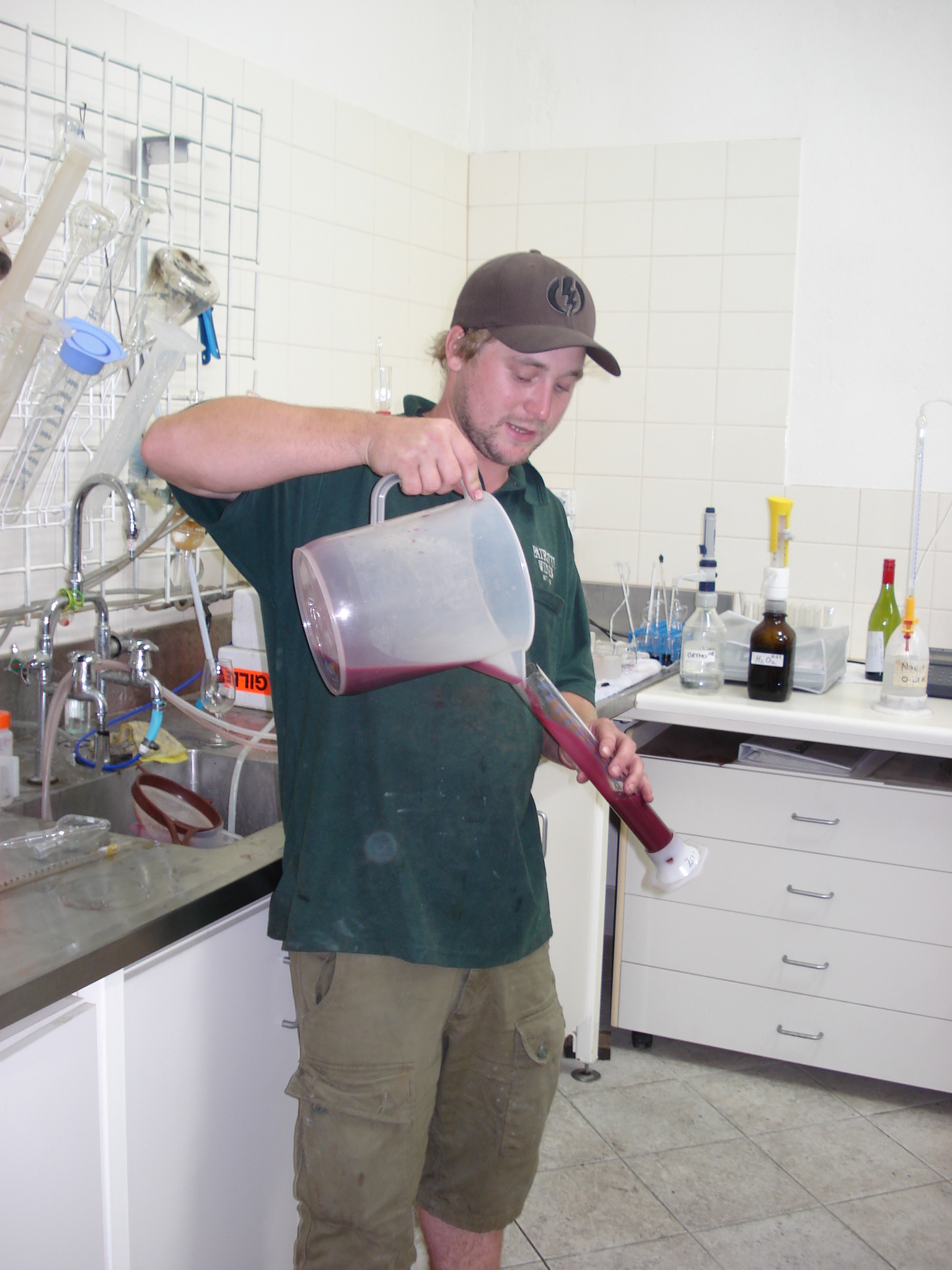
I enrolled in Foundation Winemaking back in 2007 with about 15 others and looked forward to it every week. It was one of the best decisions I have made in my quest to learn about, and work in, the wine industry. It is exciting as a newcomer to the industry to get involved in every stage of the process. One day we drove to McLaren Vale and picked shiraz grapes all morning, had lunch in Aldinga and then came back to the winery to crush the grapes. In 2007 the college used the winemaking facilities at Patritti winery in Dover Gardens. As of 2009 Strat has ensured that the college has installed and expanded its capacity at the college, while retaining a close relationship with the Patritti family.

As well as attending a weekly evening course to learn about wine, winemaking and viticulture – and sometimes to taste wines towards the end of the evening – we often met at weekends to undertake the various tasks required in winemaking, including: plunging the red wines to submerge the skins while fermenting; pressing the skins after fermentation to extract the remaining juice; and ongoing testing of the wine and applying winemaking techniques, with supervision from Strat and Patritti’s winemakers. I was also part of the class which established the vineyard at the college, which is now fully productive with a range of grapes including shiraz, cabernet sauvignon and grenache.

In 2007 we helped to bottle wine made by the previous year’s class. Our wine sat in a barrel for a year and we were called back to help bottle it with the latest class. Bottling days are so much fun – and generally followed by a barbecue and tasting of the wine that I volunteer my services still – see Wine passionados bottling Sturt Creek Estate’s ’09 cab.

For further information call (08) 8275 8325.

Posted in McLaren Vale wine, New World wine, South Australian wine, Wine news, Winemaking, wine appreciation and viticulture courses | Tagged , , , , , , | 3 Comments

2010 in review

The stats helper monkeys at WordPress.com mulled over how this blog did in 2010, and here’s a high level summary of its overall blog health:

Healthy blog!

The Blog-Health-o-Meter™ reads This blog is doing awesome!.

Crunchy numbers

Featured image

The Leaning Tower of Pisa has 296 steps to reach the top. This blog was viewed about 1,200 times in 2010. If those were steps, it would have climbed the Leaning Tower of Pisa 4 times

In 2010, there were 29 new posts, not bad for the first year! There were 67 pictures uploaded, taking up a total of 85mb. That’s about a picture per week.

The busiest day of the year was November 25th with 63 views. The most popular post that day was Puddings, pies and wine! The perfect combination at Bakehouse on Collins.

Where did they come from?

The top referring sites in 2010 were facebook.com, twitter.com, adelaide.edu.au, onlineeducationcollege.info, and blogs.adelaide.edu.au.

Some visitors came searching, mostly for http://www.tigchandler.wordpress.com, tigchandler, white cabernet sauvignon, white cab sauvignon, and adelaide’s best music… mix 102.3.

Attractions in 2010

These are the posts and pages that got the most views in 2010.

1

Puddings, pies and wine! The perfect combination at Bakehouse on Collins November 2010
3 comments

2

The Indian Wine Market – bite-sized overview! September 2010
3 comments

3

New Zealand Wine Centre – what a find! July 2010

4

Get into it! Oh boy… July 2010
2 comments

5

Social media as tools for business – a Wine 2030 blog September 2010

Posted in Blog statistics | Leave a comment

The evolution of selected private label companies and complex portfolios

Introduction
The first two articles in this discussion (links provided at the end of this article or find under Categories: ‘Private labels’ on the right hand side of this page) have set the scene for why Australians in general and the wine industry in particular should be interested in private labels, in terms of what they are, what is already happening overseas and in Australia, and the challenges and opportunities they represent. The University of Adelaide Wine2030 network is inviting comment on this issue through this series of five blogs, of which this is the third. Is this a big issue in Australia? Are you concerned or excited? Please tell us.

Recent trends in the evolution of types of private labels; major shifts in marketing paradigms and the nature of consumer goods markets; and the emergence of complex portfolios and multi-billion dollar companies concentrating at least in part on private labels – these trends have been gaining momentum overseas and are ongoing. Many of the same trends are underway in Australia and also gathering momentum.

This article provides an overview of some of the world’s largest and most successful retailers who have followed a range of private label strategies. The approaches followed by these retailers range from generics and copycats to value innovators and to complex portfolios, approaches described in the previous article.

The rise of the private label – not a new phenomenon
While the rise of private labels is a topical subject around the world, and currently hotly debated in the wine industry in Australia, the notion of private labels is not new. In Europe and America, private labels have been around since the 19th century. In the UK, St Michael has been the Marks & Spencer retail chain’s own brand for more than a century. Kumar and Steenkamp (2007) consider that the impetus for the recent surge in private labels began in earnest in the 1970s when retailers started to significantly consolidate and to develop national chains. Up until this point, manufacturers had firmly held the balance of bargaining and negotiating power in the market between retailers and manufacturers.

Since the 1970s, the balance of power has most certainly swung in favour of retail giants such as Tesco, Aldi, Costco, Walmart and Carrefour. These companies all have a significant part of their business concentrated in private labels, ranging from 10 percent for Costco to Tesco at 50 percent and Aldi at 95 percent in 2005 (Kumar and Steenkamp p.3). The two fastest growing retailers in the US – Trader Joe’s and Whole Foods – are both focusing on private labels. Speciality retailers selling their own labels have also successfully grown to go global, including IKEA, Toys ‘R’ Us, H&M and Zara.

Private labels are growing strongly around the globe and are expected to continue to do so. The range of products covered does not seem to be limited, enveloping all kinds of groceries, including alcohol; clothing; appliances; furniture; financial services; telecommunications, and so on.

Australia is a back runner in the private label race but is quickly catching the back markers. Private labels accounted for 23 percent of grocery sales in 2010 according to independent researcher IbisWorld, which expects the share to increase to 30 percent in five years. This compares to a figure of 41 percent in the UK and similar rate in the US, 36 percent in Belgium and 31 percent in Germany, with France and Spain not far behind.

Overview of most successful private label companies
I have chosen a shortlist of companies to profile based on the key global trends and on what is important to Australian markets, including wine retailers. Aldi and IKEA are already established in Australia and the supermarket chains Coles and Woolworths are comparable entities to the Tesco, Walmart and Asda of the UK and US. While various chains take different approaches, they are all competing for consumer expenditure and are all employing private label strategies to some extent.

This article gives a synopsis of the birth and development of these companies and summarises the approaches taken and the success achieved in terms of global reach and market power. Most of these companies are still expanding – the possibilities are not yet known.

Aldi – “Top quality at incredibly low prices”

What is Aldi?
Aldi is a German-based multinational selling groceries and other items in ‘no frills’ stores, passing on low prices to customers, and with a strong focus on private labels. It is Europe’s biggest “hard discounter” (Aldi: The Next Wal-Mart? 26 April 2004, Business Week, pp.20-23).

Background
Aldi, short for ‘Albrecht Discount’, was established in Germany by the Albrecht brothers, Karl and Theo. The name Aldi was first used in 1962 after the brothers legally and financially split the company between them in 1960 over a disagreement about whether to sell cigarettes at the till. The Aldi chain remains in two separate groups: Aldi Nord (North) and Aldi Süd (South).

Reach
There are over 8,200 Aldi stores worldwide, of which Aldi Nord accounts for a slightly larger share of 52 percent. Aldi Nord has 35 regional companies with about 2,500 stores in Western, Northern and Eastern Germany. Its international markets are in Belgium, the Netherlands, Luxembourg, France, Spain, Portugal and Denmark.

Aldi Süd has 31 regional companies with about 1,600 stores in Western and Southern Germany. Its international markets are the US, the UK, Australia, Ireland, Austria, Switzerland and Slovenia. Most recently stores were opened in Hungary, Greece and Poland.

The Albrecht brothers also own Trader Joe’s, a US-wide chain with over 250 stores selling around 80 percent private labels and focusing on low prices.

Company philosophy
As discussed in Article 2 Aldi is an example of a value innovator, with marketing slogans such as “Spend a little, live a lot” and “Top quality at incredibly low prices”. It applies a number of key cost-cutting strategies and these savings are passed on to consumers. Some examples of how it keeps costs down are:

  • Aldi limits product numbers to around 700 distinct items or stock-keeping units (SKUs), compared to nearer 25,000 for a typical supermarket or over 100,000 for Walmart.
  • Aldi mainly sells staple items including food, beverages and toilet paper. Many of these (90-95 percent) are private labels. There are some brands sold, such as HARIBO sweets in Germany, Marmite and Branston Pickle in the UK, and Vegemite and Milo in Australia, but these are exceptions.
  • Distribution centres are usually located away from urban areas, near to main roads to facilitate transporting the merchandise to the stores.
  • Until recently Aldi accepted only cash. It now takes debit cards in the US, the UK, Australia, Austria, Belgium, Denmark, France, Portugal, Spain, the Netherlands, Switzerland, Ireland and Slovenia. Aldi generally does not accept credit cards, though Aldi Australia accepts MasterCard and Visa for a 1 percent surcharge.
  • There is a ‘no frills’ approach – customers take items directly from cardboard boxes in pallets.
  • Aldi charges for shopping bags. Customers can bring their own, but often use the empty cardboard boxes to carry their shopping. Once scanned, items are put into the shopping trolley and the customers pack their own shopping away from the tills.
  • In Europe, Australia, the US and parts of Canada a coin or token (purchased from Aldi) is required to use a shopping trolley. When the coin or token is inserted, the trolley is unlocked. When it is returned, the customer is refunded their coin. This saves on staffing and on stolen trolleys.
  • Staff levels are kept to a minimum. However, due to the efficient checkout system, long queues do not always translate into a longer wait than in other supermarkets.
  • Advertising expenditure is kept down, although the apporach differs between countries. In Germany the only advertising is through a weekly newsletter Aldi informiert (“Aldi informs”) that is distributed in stores, by mail, and in local newspapers. Print and television advertisements have been used in the UK, US and Australia, with Aldi’s “Smarter Shopping” slogan.
  • Aldi has weekly special offers which are available in limited quantities and for one week only. This is most common with more expensive products such as electronics or appliances. This retains interest in Aldi’s products and allows it to sell other lines as they become available.

Tesco – “Every little helps”

What is Tesco?
Tesco is a UK-based chain, starting out in the grocery line and expanding to incorporate a complex portfolio of all levels of private label products as well as branded products.

Background
The company was founded by Jack Cohen in 1919. The Tesco name first appeared in 1924 when Cohen bought a shipment of tea from T. E. Stockwell and combined the initials with his own name. He opened the first Tesco store in 1929 in Edgware, south-east England, selling food and drink. Tesco has since grown to several thousand stores and sells a wide range of products including clothing, financial services, health, home and car insurance, electronics and internet services.

Reach
Tesco is the third largest retailer in the world measured by revenues after Walmart and Carrefour, and the second largest measured by profits. In 2010 it had around 2,500 stores in the UK and a similar number overseas. Its headquarters are in the UK where it is the leading grocery retalier with about 30 percent of the market, and it operates in 14 countries across Asia, Europe and North America.

Company philosophy
Tesco has entered the market for a range of product types (groceries, alcohol, financial services, and so on) and price levels (from budget generics to luxury items), thereby widening its market base to appeal to all kinds of consumer.

Starting out as aiming to be seen as competitive and good value, Jack Cohen’s business motto was “pile it high and sell it cheap”The Independent (London), 16 December 2001 and later “You Can’t Do Business Sitting On Your Arse” (YCDBSOYA).

The approach has since become more complex. Tesco has acquired existing chains, entered into joint ventures, and shown market leadership in new areas. For example, in 1987 Tesco acquired the Hillards chain of 40 supermarkets in the North of England, and in 1994 the 57 William Low stores in Scotland.  In 2006 Inverness was branded as ‘Tescotown’, because over 50p in every £1 spent on food was believed to be spent in its three Tesco stores.

Joint venture partners include Esso (part of Exxonmobil) which sells fuel via Tesco, with Esso operating the forecourts. Tesco has also entered into joint ventures with O2 to set up the Tesco Mobile phone network in Ireland, and has a UK division providing internet, mobile and home phone services. Tesco’s international expansion has included joint ventures with the Samsung Group in South Korea and Charoen Pokphand in Thailand.

Tesco can boast market leadership in a range of new areas. For example, as early as 1996, Tesco was the world’s first retailer to provide a full home shopping service. It has also been pioneering in its expansion into many of the additional product lines.

The philosophy of appealing to all kinds of consumers in all parts of the market is reflected in the range of types of stores, and their selected locations. Tesco has six store types to appeal to location and customer preferences:

  • Tesco Extra stores are large hypermarkets that stock nearly all of Tesco’s product ranges and are mostly located away from town centres.
  • Tesco Superstores are standard large supermarkets, stocking groceries and a small range of non-food goods.
  • Tesco Metro stores are sized between Tesco superstores and Tesco Express stores. They are mainly located in city centres, the inner city and on the high streets of towns.
  • Tesco Express stores are smaller neighbourhood convenience shops, stocking mainly food with an emphasis on higher-margin alongside everyday essentials. They are located in city centres, small shopping precincts in residential areas, small towns and on Esso petrol station forecourts.
  • One Stop include some of the smallest convenience stores.
  • Tesco Homeplus is a non-food venture in the UK selling poducts for the home.

The other main aspect of Tesco’s approach that is of key interest to this series of articles is the complexity of its portfolio. As well as selling branded products, Tesco has launched private label ranges in the generic ‘Value’ category; a range of ‘Tesco’ labels that partly started as copycat products; and the luxury/premium ‘Finest’ range. Tesco successfully competes with branded products across all price categories and has earned customer loyalty. Furthermore, as described above, Tesco has entered into markets for a wide range of product categories including food, alcohol, clothing, homeware, phone services, financial services, fuel, software, and even film-making.

As Citigroup analyst David McCarthy is quoted as saying, Tesco has “pulled off a trick that I’m not aware of any other retailer achieving. That is to appeal to all segments of the market”.

Walmart – “Save Money Live Better”

What is Walmart?
Walmart (branded as Wal-Mart until 2008) is a US-based chain of large discount department stores and warehouse stores, with operations across North America, South America, Asia and Europe.

Background
Walmart was founded by Sam Walton in 1962, with its headquarters in Arkansas in the southern US. The first Walmart Supercenter opened in Missouri in 1988. It started selling private labels in 1991 with its Sam’s Choice beverage line and saw immediate success. It branched out internationally in 1994 with the acquisition of the Woolco division of Woolworth Canada, Inc. In 1995 it opened stores in Argentina and Brazil, then moved into the UK in 1999, when it bought the grocery chain Asda. Walmart also owns the Sam’s Club chain in North America.

In some countries Walmart operates under another name, such as Asda or Asda Walmart in the UK, Walmex in Mexico, Seiyu in Japan, and Best Price in India.

Reach
Walmart is the largest grocery retailer in the US. In 2010 it was the world’s largest public corporation by revenue, according to the Forbes Global 2000 for that year. Walmart operates over 4,000 stores world-wide in 15 countries and employs more than 2 million workers, making it the single largest private employer in the US and Mexico, and one of the largest in Canada. There are over 600 Sam’s Clubs in the US and a further 100 in Brazil, China, Mexico and Puerto Rico.

Company philosophy
Walmart’s philosophy is to sell a wide range of products at low prices. Its aim is to give customers the best value for money as reflected in its slogan “Save Money Live Better,” which replaced the “Always Low Prices, Always” slogan in 2007. Its Asda stores have the logo “Saving you money every day”.

Like Tesco, Walmart provides a prime example of operating a complex portfolio. It has a number of retail formats selling a wide range of branded products while also steadily increasing its range of private labels. Walmart retail formats include: small markets (bodegas); food and drug (pharmceutiacls) stores; discount stores; general merchandise stores; cash and carry; supercentres; clothing stores; membership warehouse clubs; and restaurants. The three main store types in the US are:

  • Walmart Discount Stores selling general merchandise and groceries. Many also have a pharmacy, a bank branch, fast food outlet, optical centre, garden centre, cell phone store, photo delevopment service, a Tire & Lube Express, and a fuel/gasoline station.
  • Walmart Supercenters are hypermarkets with a full-sized supermarket with delicatessen, fresh foods and forzen foods, and also selling everything that the discount store does.
  • Walmart Neighborhood Markets are smaller grocery stores selling groceries, pharmaceuticals, and other general merchandise.

The other main Walmart chain in the US is Sam’s Club – a chain of membership warehouse clubs selling a limited range of groceries and general merchandise. Some stores also sell fuel. Customers have the choice of buying an annual membership, buying a one-day membership, or paying a surcharge if they do not wish to pay this fee. These stores have been aimed primarily at small business, being open early exclusively for business members. The chain’s slogan was “We’re in Business for Small Business.” More recently, in an attempt to widen the customer base, the slogan was altered to “Savings Made Simple”.

The Walmart stores sell approximately 40 percent private labels, some of which are co-branded with manufacturers. Walmart has been selling its own store brands since 1991, starting with its Sam’s Choice range of drinks manufactured by Cott Beverages exclusively for Walmart. It also sells under own store labels Great Value and Equate in the US and Canada, and Smart Price in the UK Asda outlets.

Walmart focuses on keeping the most profitable products on its shelves and monitors sales as does any other retailer, but unlike other retailers, it does not charge a fee for providing a slot on its shelves. Instead it provides incentives for store managers to stock the most popular products and drop the least popular.

Joint ventures and ongoing innovation have been key to the company’s continued growth and profitability. Examples of joint ventures include:

  • Some supercentres sell gasoline through Murphy Oil Corporation, Sunoco, Inc., or Tesoro Corporation.
  • Sam’s Club is entering into a joint venture with Dell and eClinicalWorks.com to provide a software package to physicians in small practices to manage their medical records.
  • In 2010, Walmart jointly produced two full-length family movies with Procter & Gamble in which the characters using both Walmart and Procter & Gamble branded products. There are more movies in production.
  • Walmart entered into a joint venture with Bharti Enterprises to open retail stores in India.

In terms of innovation and developing its image and reach, key projects have included the following:

  • Walmart has employed consultants to find ways to improve energy efficiency in production and distribution. It has a stated goal of being a good steward for the environment. Initiatives have included increasing the fuel efficiency of the truck fleet, eliminating excess packaging from product lines and cutting waste to a minimum.
  • Walmart has created its own electric company, Texas Retail Energy, to supply its stores at wholesale power prices and save millions of dollars.
  • Since 2006, Walmart has been selling generic drugs for $4 per prescription, compared to the average price of $29 per prescription (and around $100 for manufacturer-branded drugs). It says it is achieving this by saving costs through mass distribution as for other products.
  • In order to appeal to the Hispanic consumers in the US, Walmart introduced “Supermercado de Walmart”.

IKEA – “Love your home”

What is IKEA?
IKEA is a Dutch corporation (with Swedish origins) selling ready-to-assemble furniture, appliances and homeware, with over 300 stores in 37 countries across Europe, North America, Asia and Australasia.

Background
IKEA (Ingvar Kamprad Elmtaryd Agunnaryd) was founded in 1943 in Sweden by a 17-year-old boy named Ingvar Kamprad. He named the company after himself, the farm on which he lived (Elmtaryd), and his home village (Agunnaryd in southern Sweden).  

A group of companies now form IKEA and are controlled by the privately-owned Dutch corporation INGKA Holding B.V. which is wholly owned by a tax-exempt, not-for-profit Dutch foundation called Stichting INGKA Foundation. The company is run on a franchise basis, with Dutch company Inter IKEA Systems B.V. owning the IKEA concept and trademark.

IKEA of Sweden designs the products in the IKEA range, and Swedwood, owned by INGKA Holding B.V. is responsible for purchasing and supply, and the manufacturing of the IKEA furniture, most of which is done in Asia and Europe. Swedwood produces wood-based furniture and wooden components in 46 production units in ten countries.

IKEA opened its first store in Sweden in 1958 and expanded to Norway and Denmark in the 1960s. The first stores outside Scandinavia were opened in the 1970s in Europe, Asia and North America and the chain has expanded strongly ever since, with Germany its largest market. Australia got its first store in 1975.

Reach
IKEA is the world’s largest furniture retailer. In 2009 there were 267 IKEA Group stores in 25 countries with 590 million visitors. The top countries in terms of sales were Germany 16 percent, US 11 percent, France 10 percent, UK 7 percent and Italy 7 percent. There are an additional 37 stores in 16 countries owned and run by franchisees outside the IKEA Group.

In 2009, 198 million copies of the annual IKEA catalogue were printed in 56 editions and 27 languages.

Company philosophy
IKEA sells a large range of products, including 9,500 home furnishing products which are “designed to be functional and good looking but at a low price” (Reference: IKEA website). The products are all designed and developed by IKEA of Sweden.

IKEA stores are large warehouse-type buildings usually located outside of city centres to save costs and for traffic access. Most of the furniture products are sold in boxes to be carried home and assembled by the customer. This permits IKEA to minimise costs and use of packaging. Many of the IKEA products are manufactured in developing countries to keep costs down. The largest suppliers are China, Poland and Italy, with Sweden in fourth place.

IKEA is keen to promote an environmentally friendly image. On the IKEA Australia website, the stated responsibility of IKEA is:

“Low prices are the cornerstone of the IKEA vision and our business idea – but not at any price. At the IKEA Group, we believe that taking responsibility for people and the environment is a prerequisite for doing good business.”

IKEA products are each given a single word name, most of which are Swedish and each product range tends to have a theme. For example, beds, wardrobes and hall furniture have Norwegian place names; garden furniture is named after Swedish islands; chairs and desks are given men’s names; and materials and curtains have women’s names.

The main marketing tool for IKEA is its annual catalogue, distributed both in stores and by mail. It has been said that more copies of the IKEA catalogue are printed each year than the Bible.

Innovation and joint ventures continue to help build IKEA’s success and reach. Examples include:

  • IKEA has expanded its product line to include flat-pack houses, with a product named BoKlok launched in Sweden in 1996 in a joint venture with Skanska.
  • In 2008, IKEA UK launched a virtual mobile phone network called Family Mobile,using the T-mobile network.
  • IKEA promotes its ongoing environmental and social projects and initiatives – a way to bolster its image and promote customer loyalty. The website provides a number of examples.

The layout of the stores and offering cheap restaurants and childminding are also innovative and effective strategies for attracting customers:

  • Most IKEA stores are very large with few windows with a blue and yellow decor – the colours of the Swedish flag. The layout is such that the customer must follow a one-way system that takes them through every department, although some shortcuts may be available. This is a novel design for a retail outlet.
  • Many stores have a play area called Småland, which is the name of the province where Ingvar Kamprad was born. Parents can leave their children at the playground and collect them later and are given free pagers so that the staff can contact them if needed.
  • Many IKEA stores have restaurants serving traditional Swedish food such as Swedish meatballs, and they open early to offer cheap breakfast deals. For example, in the Netherlands for €1 the breakfast includes a croissant, bread roll, jam, cheese, an egg and coffee or tea. In Australia $2.95 – $3.50 buys bacon, scrambled eggs, sausage, hash brown and tomato, with a $2 vegetarian option.

So what is there to learn from these four ‘super’ companies?
On first sight it may seem that these companies have little in common, all based in different countries with diverse heritage and background and individual approaches to their business. However, all of these companies have a number of key features in common:

Firstly, all are highly successful multinationals and have become so by adapting to their target market, by constant innovation, and joint ventures where appropriate.

Secondly, they all place great emphasis on cost-cutting and passing on the savings to consumers. This links in with the heavy presence of private/own brand labels, which is the hot topic being debated around Australia as we follow in their footsteps, and brings us back to the theme of this series of articles.

A third and final point for this article is that these companies realise just how vital it is to build consumer belief in the companies. Attracting consumers requires people to believe that the products are good quality for the price. Then to retain the customers, the stores need to build loyalty in their own brands and this is a much more complex challenge. Consumer loyalty is the magic key to success and as Kumar and Steenkamp note (p.90) ‘Private labels build store loyalty’. How do they do this? Article 4 in this series takes up this chain of thought… Coming soon!

Main references in this article:
Nirmalya Kumar and Jan-Benedict E.M. Steenkamp, ‘Private Label Strategy’, Harvard Business School Press, 2007.

IbisWorld forecasts, www.heraldsun.com.au, 6 August 2010, ‘Consumers reject traditional beer and wine brands to chase best price’

Other articles in this series:

Article 1: Private labels – what’s the problem? Is there a problem? What about wine?

Article 2: Private labels – what are they?

Article 4: The key to success – building and retaining customer loyalty

Article 5: Private labels – back to Australia and back to wine

Posted in New World wine, NZ wine, Private labels, UK wine, Wine news | Tagged , , , , , , , , , , , , , , , | 7 Comments

Tigs takes to the Riverland!

I headed north east from Adelaide to visit the Riverland for the first time in my four years in South Australia. Working for the University of Adelaide’s Wine2030 network this had been a big omission from my local wine education since the Riverland is home to some of the country’s wine industry giants so I was keen to put that right.

For those who do not know this area, the Riverland is a three hour drive from Adelaide, depending which part of Adelaide you are starting from of course – I was starting at the ‘wrong’ side – the south west. Just to confuse me, when I asked friends how to get there I got two very different answers – via the Barossa and via the Adelaide Hills – so I went one way and came back the other, driving through two more of the state’s key wine-producing areas.

In preparation I was told to prepare for the locust plague – I had only heard of these as biblical events – but nevertheless my mate Brian put mesh across the front grills of my car. Heading off via Tailem Bend bound initially for Loxton where I would be staying, I drove through several clouds of locusts and accumulated a row of carcasses along the windscreen wipers and an array of splats on the windscreen. The blue-tongue lizards along the roadside were loving the free feast of readily killed locust mash. The sight of a red-bellied black snake reminded me I was heading into the Aussie countryside.

Riverland vines, December 2010

Beautiful, vast and typically Australian, with apricot orange earth, brush scrub and gum trees, I felt instantly relaxed in the Riverland. After an usually wet last few months of 2010, there was more greenery than would normally be expected at this time of year and the vine canopies were rich and full (pictured). Many commonly parched areas were flooded, with the river breaking its banks in multiple places. The stranded, strangely melancholic but peaceful park bench in the photo is by the river in Loxton.

Park bench during flooding in Loxton

On this trip I visited the main wineries of the region – Angove’s, Berri Estate, Kingston Estate and Banrock Station (see the blog entitled “Banrock Station – wetlands and wine”), and the smaller Salena Estate. Everyone I met was very welcoming and interested in hearing about the Wine2030 network, which aims to link wine-related research at the University of Adelaide with the wine industry, encouraging communication and cooperation.

Angove

An early Angove’s wine bag in a box – patent registered by Tom Angove in 1965

First I went to Angove in the town of Renmark. Angove is one of Australia’s largest family-owned wineries, established in 1886. Tom Angove who died recently was the inventor of the bag in a box wine marketing concept (pictured). A lovely English lady called Jenny talked me through the many ranges: Vineyard Select is the premium range; Nine Vines is next; then comes Long Row; and there is also Misty Moorings, Butterfly Ridge and Red Belly Black. I tried quite a few, of course the Vineyard Select was best, using typical regional varietals: cabernet sauvignon from Coonawarra, riesling from Clare Valley, shiraz from McLaren Vale, sauvignon blanc from the Adelaide Hills and chardonnay from Limestone Coast. Most of the other ranges used more locally sourced grapes.

Angove is also known for St Agnes brandy, and for Bookmark and Paddle Wheel brands of fortifieds and makes Stone’s Green Ginger Wine under licence.

I was surprised to see a range of other iconic international brands on sale which Angove distributes, including Mount Riley and Gibbston Valley from New Zealand; Moss Brothers, Wick’s Estate and Shingleback from Australia; Nicolas Feuillate from France; and Glenfarclas (whisky) from Scotland.

This was a cellar door at which I spent well over an hour, with so many wines to try, friendly staff and lots of Angove’s memorabilia to look at. As with the wineries I was yet to visit the Riverland wine prices were all very low by Australian (and imported) standards. Misty Moorings were just $5.60 a bottle, up to $19.75 for the Vineyard Select range.

Berri Estates
I headed next to Glossop, between the towns of Berri and Barmera to visit the enormous operation of Berri Estates Winery, established in 1922. Michael at the cellar door told me that this was Australia’s largest winery and distillery and is still expanding. The parent company is Constellation Wines Australia (CWAU), formerly BRL Hardy. So at the cellar door there were a range of Constellation wines on sale including Hardys, Banrock Station, Tintara, Yarra Burn, Omni, Renmano, Leasingham, Barossa Valley Estate, Houghton and Nobilo (of New Zealand).

Berri Estates Winery

At this particular site there were a staggering 2,000 tanks on site with a capacity of about 220 million litres, the largest tanks holding up to 280,000 litres each. During the 2009/2010 vintage, they crushed 171,000 tonnes of grapes at this winery. I had never seen such an enormous operation.

At this site they made mostly wines for the Nottage Hill label, Banrock Station, the base wines for the Omni sparkling, and fortified wines – mainly sherry and ports. I also tried Berri Estates’ quince liqueur brandy called Marnique which was rather delightful! Perfect on a cool night by a warm fire, 25% alcohol, it gave a spicy little buzz!

Salena Estate
On my way back to Loxton I stopped by Salena Estate – who had just won three trophies and a gold medal at the Australian Alternative Varieties Wine Show for their 2010 Bianco d’Alessano, Ink Series. Once again there were several wine ranges, including Tyrone Estate and an organic wine range. The lady who served me – Chantelle – told me that the wine ranges were named after the son and daughter of the owners – Salena and Tyrone, a unique legacy for your offspring!

Australian Alternative Varieties Wine Show for 2010 Bianco d’Alessano, Ink Series

I was interested to try their petit verdot which I quite enjoyed – very soft with a berry fruit burst on the palate, giving pleasing chocolate and spice. A little young at 2009, I shall cellar that one.

Kingston Estate
On day two I headed to Kingston Estate winery at Kingston-on-Murray, around 220km from Adelaide. It was not a cellar door facility but their wines are easily available to try in Adelaide. I took the opportunity to talk to them about the Wine2030 initiative and could see that this was another enormous facility, with huge wine tanks. I discovered that this is the tenth largest Australian wine producer by volume. More than two thirds is exported.

Kingston Estate winery is also one of the largest family-owned wineries in Australia. The founders, Sarantos and Constantina Moularadellis, came from Greece, as reflected in the winery’s logo being the head of Dionysus, the Greek God of wine. Their son Bill completed his oenology degree in 1985 and Kingston Estate Wines was officially established.  Bill Moularadellis is the Managing Director and chief winemaker.

There are two wine ranges – Kingston Echelon and Kingston Estate. Kingston Echelon is the premium range of limited release varietal wines – chardonnay, petit verdot, cabernet sauvignon and shiraz. The Kingston Estate range uses fruit “from the two regions that will allow us to express the true essence of each varietal” (cited from the Kingston Estate website). This range includes chardonnay, petit verdot, cabernet sauvignon and shiraz plus merlot, sauvignon blanc and pinot gris.

Kingston Estate has the largest single planting of petit verdot in Australia. The 2002 Kingston Echelon Petit Verdot was awarded top gold at the 2003 Royal Melbourne show.

Banrock Station
I was very much looking forward to the last stop – Banrock Station – not just because it is a huge and renowned winery in Australia but also because of the wetlands, where I knew I would be able to take a long walk and learn about their conservation initiatives. I was not disappointed – the Banrock Station Wine and Wetland Centre is situated in such a beautiful setting with panoramic views of the wetlands. Check out the next blog “Banrock Station – wetlands and wine” for some interesting snippets of information and some glorious photos. Here’s a sneak peak:

Wetlands at Banrock Station

All in all, I loved the Riverland – wine, scenery and most of all people.

Tigs
xx

Posted in Cabernet sauvignon, New World wine, Riverland wine, Sauvignon blanc, South Australian wine, Syrah/Shiraz | Tagged , , , , , , , , , | Leave a comment

Banrock Station – wetlands and wine

Wetlands at Banrock Station

The Banrock Station Wine and Wetland Centre is in Kingston on Murray in the Riverland. For an account of my trip to the Riverland in December 2010 read “Tigs Takes to the Riverland!”. I felt that Banrock Station needed its own blog, since I took so many photos and there is a great tale to tell about the wetlands as well as the winery. As anyone who follows my blog will know, I like to veer off the well-worn wine commentaries and include some unusual and quirky items such as puddings, pies and wine, and bottling wine in an adult winemaking course, as well as the usual winetasting notes and wine news. I always welcome feedback too so feel free, I do read it all.

I also like to include lots of pictures as I have the concentration span of a gnat. This blog has more photos than usual because it was that kind of place (apologies for the splodge on some of them – I have since cleaned the lens!).

Banrock Station Wine and Wetland Centre, vines in foreground

Back to Banrock Station – what a well-thought-out and well-executed venue to appreciate wines, good food, panoramic views, wildlife and relaxation. I loved this place, spending about three hours there and only forcing myself to leave to dodge peak hour Adelaide traffic (I failed).

The Hospitality Manager Karen Sellar was keen to hear about the Wine2030 network at the University of Adelaide (my primary reason for visiting) and was extremely informative about the wetlands, telling me that this was the first time it had been flooded to this extent since the centre was opened in 1999. Because of this they had needed to redo all of their brochures for visitors mapping out walks and talking about the wetlands. The new map shows about two-thirds of the walkway for visitors sitting under water, so for safety purposes visitors can only walk along a much shorter section. Some temporary lookouts had been erected at a couple of locations to really take in the event.

Karen told me it was the norm to have a managed dry and wet cycle, controlling the Murray River flow to stimulate the breeding of native birds and animals. Banrock Station has been managing this wetland since 1994. Flooding is a natural part of the cycle of the wetlands and is necessary for the survival of the ecosystem. The current flows in late 2010 are expected to reach between 65,000 to 80,000 megalitres (ML) per day, compared to drought levels of nearer 2,000 ML/day. The last flood was in 1996, with a comparable peak flow of 76,000 ML/day. However, the current flood is relatively minor by historical standards, as information boards along the walk tell you – in 1956 there was a “1 in 200 year event” with peak flows of 341,000 ML/day.

Wetlands at Banrock Station, December 2010

Bird hide flooded, Banrock Station, December 2010

“In 2002, the wetland was listed as internationally significant under the Ramsar Convention on Wetlands, recognising its importance as habitat for threatened species and migratory birds” (source: Banrock Station brochure).

The flooding has a number of benefits – there had been concern about the survival of the native River Red Gum trees and Black Box trees and many had been dying as a result of years of drought, but this flood would hopefully save the remaining trees and replenish groundwater for years to come for the many species of trees and plants in the area. The floods are also good to wash some of the salinity out to sea, which also helps the plants and native fish. I took a number of photos – the views were changing daily as the water levels continued to rise.

Walking around I saw several species of birds including white heron, black wading birds, various types of parrot and budgies of all colours, black swans, and smaller birds that looked like wren-sized swallows – clearly I am not an ornithologist!

There were also lots of dragonflies and lizards (and dastardly flies!) and probably many more species that I did not spot – probably because they spotted me first! The water I am told is also home to many species of frogs and fish.

After 1.5 hours of wandering around the wetlands I headed back up to the centre to taste some wines – particularly the ones you can only buy at cellar door – the Mediterranean Collection. There were three red and three white varietals: savagnin blanc, pinot grigio, fiano, montepulciano, tempranillo and durif. Unfortunately the durif had sold out but I did get to try the others and came away with a bottle or three! There was also a limited range of organic wines. Meredith and Chrissy at cellar door were very friendly and knowledgeable ladies.

And to round off, here a few more pics I wanted to share. Enjoy!

Tigs

This slideshow requires JavaScript.

Posted in New World wine, Riverland wine, South Australian wine | Tagged , , , , , , | 2 Comments

Private labels – what are they?

The topic of private labels in the wine industry was introduced in the previous article. This series of articles is being released as part of a Wine2030 (University of Adelaide) initiative to invite discussion around this current and emotive development in Australia. To access the other articles in this series, click on ‘Private labels’ under ‘Categories’ on the right hand side of this blog.

This article looks first at private labels in general and later I shall return to consider their application specifically in the wine industry. The research I present in this series of articles will inform the discussion around the following questions:

  • Are private labels a cheap and cheerful copy of branded products?
  • Are private labels as good?
  • Do they increase or decrease choice?
  • Are they a fad or a growing and/or permanent phenomenon?

In order to have an informed discussion about private labels it is necessary to put some definitions in place and to understand exactly what we are talking about. In my research I have studied key texts, consulted with industry experts, and also kept an eye on what is being said online and in various media sources. An excellent and comprehensive reference in this research has been the book by Kumar and Steenkamp entitled ‘Private Label Strategy: How to Meet the Store Brand Challenge’ – an easy-reading and highly insightful text. I have also consulted Lincoln and Thomassen’s ‘Private label: turning the retail brand threat into your biggest opportunity’.

I will look at some of the most successful private labels companies in the third article in this series, after first providing an overview in this article of the classification of private labels. I then pull together my findings in terms of the approaches of these companies and turn my attention back to wine and Australia.

Private labels – a definition
Private labels may also be referred to as home brands, own brands, own labels, store brands, retailer brands and probably more. Kumar and Steenkamp define a private label “to be any brand that is owned by the retailer or the distributor and is sold only in its own outlets” (p.20).  Therefore brands such as IKEA, Gap and H&M, Woolworths Select and Coles SmartBuy are private labels because they are sold only in their own stores and their products are not sold through any other outlets.

Retailers tend to concentrate on any or all of four key groupings of private label lines. These are: generics, copycats, premium store brands and value innovators. There are strategies associated with each of these groupings, each of which could be the subject of its own article. For each of these label types, I shall provide a simple description of the approach, the driving forces behind them and examples.

1.       Generics

Generic private labels of Australian retailers Coles, Woolworths and IGA

Private labels first came onto the scene several decades ago in the US and Europe, and more recently in Australia, as cheap, inferior products. They were presented as ‘generics’, often not bearing the name of the retailer, but simply the name of the product, such as ‘milk’ or ‘butter’, in plain script on a white plain background. Mostly basic food products, canned goods and paper goods, they were offered at low prices, competitive with the lowest priced product in that category. The product range appealed to the budget-sensitive shopper. They were seen as low quality but cheap. Retailers rarely run price promotions because the product is cheap already and there is usually only one product to choose from. When I was a student living on very limited funds I loved them.

Generics are common in Australia, and do bear the name of the retailer – Woolworths has its Home Brand; Coles has its SmartBuy; and IGA has Black & Gold. In the UK, Tesco has a Value line, and Sainsbury has its Low Price range. South Africa’s Pick n Pay supermarket chain has the No Name line.

2.       Copycats
Copycat store brands carry the name of the retailer and tend to have packaging and price points very close to the products that they compete with. The retailers tend to target branded products that are already successful then produce a copycat that has similar ingredients, packaging and pricing. Copycat retailers can thereby cash in on the success of the branded product without having to incur the costs associated with developing the product and researching the market. Marketing costs are also kept down since the product is instantly recognisable as being associated with the product it is copying. With copycat brands there is no cost of failure to absorb since only successful products are targeted. The retailer tends to produce a similar product and offer it at a lower price than the branded product – so the message to the consumer is that it is as good but cheaper.

Examples of copycat products by Coles compared to the branded products

Examples of copycat products by Coles compared to the branded products

The advantages of having copycat brands is not only to make profit on the sale of the product itself, but it creates competition for the existing manufacturer branded products as well as increasing the retailer’s bargaining power with the manufacturers, since the retailer has the option to promote its own brand in competition with the original brands.

There are many examples of copycat products in Australian supermarkets. Walking around you will see private label copies of established manufactured brands in a wide range of products – just looking in the confectionary and chocolate biscuits aisle there are many examples. The image of some examples from Coles shows similar product and colour schemes and same size packaging for flavoured tinned tuna, tinned spaghetti and tea bags going head to head with products from John West, Heinz and Lipton, respectively. Even the Aussie icon brand of Tim Tams has been openly copied by the major retailers, selling a similar product in similar packaging, with the Coles or Woolworths name on the pack. This is also one of the strategies followed by UK supermarkets such as Tesco and Sainsbury.

The Spanish clothing chain Zara is a very successful copycat company that sells private labels only, producing fashion clothing at very low prices that imitates famous designers and well-known brands. They employ talented and unknown young designers to pick up on key trends and translate them into clothing for the Zara chain. Its strategy allows it to operate with extremely low costs of advertising, staffing, market research, and so on, that the manufacturer brands continue to incur. This chain has been so successful it is a multinational company and is due to open its first Australian store in 2011 in Sydney.

3.       Premium store brands
As retailer strategies have developed, the approaches have evolved to incorporate premium store brands. Retailers have seen the opportunity to differentiate their products and thereby target a whole new section of the market. The latest trend is to establish high quality products with distinctive packaging, presented as a whole new product line by the retailer, targeted at competing with the top brands in the range.

Kumar and Steenkamp define two types of premium brands: the premium private label which is exclusive, higher in price, and superior in quality to competing brands; and the premium-lite store brand which is promoted as being equal or better in quality to the competing brands, while being cheaper.

In the UK, Sainsbury’s premium line is called Taste the Difference, Tesco has Tesco Finest, and Asda has Extra Special. These labels tell the consumer that this is the best product, and the packaging is also targeted to this effect. The Marks & Spencer chain in the UK can charge premium prices for many of its own label food products as it has successfully marketed its food lines as gourmet, high-quality food. In Australia, Woolworths Select is a premium-lite store brand – it offers a price advantage while also offering similar quality to manufactured brands. Coles has introduced a Coles Finest range.

With premium pricing, the store brands compete against the premium branded products in a particular product range, but also offer distinctive elements while benefiting from consumer loyalty.  Once consumers are loyal to the brand, they are more likely to trust other products in the range. For example, Sainsbury has over 800 products in its Taste the Difference range.

As part of the premium private label approach many retailers have adopted the strategy of co-branding. This is when the retailer join forces with a prominent brand manufacturer. This has been seen in the UK with the Waitrose supermarket range of labels called ‘in Partnership with’, for example, Waitrose “in Partnership with” St Hallett Wines 2008 Barossa Shiraz Reserve from Australia which sells for £8.99 – not the cheaper end of the wine range. In the US, Costco has co-branded products in its premium Kirkland Signature range with Starbucks on some coffee products, and with Hershey and Nestlé with some chocolate and confectionary products.

4.       Value innovators
Value innovator own labels are the fourth main category of private labels. The retailers following this approach have focused on cutting down costs and processes to simplify the production and marketing of product ranges, so that a good quality product can be offered at very low prices. The Swedish company IKEA has done this with furniture, cutting costs through the whole process, as well as passing on the collection and construction of items to the consumer. By far the most successful retailer across Europe has been Aldi, a company now making headway in Australia, with over 200 stores.

The value innovator approach differs greatly to the generic, copycat and premium label approaches.   There are a number of key principles that must be adhered to for this approach to be successful.

  • Limited number of products
  • Low costs of production and marketing
  • Good quality products at low prices

Taking Aldi as the example here, Aldi offers around 700 products, which is very limited compared to supermarkets which typically have several thousand. Aldi has over 90 percent private labels in its stores, giving its own names to products, such as Bueler Cola and Royal Avenue toilet tissue. The turnover per product is higher than any other retailer’s (Kumar and Steenkamp, p.64) which assists in negotiating power with suppliers. Aldi keeps its system costs down – “the total costs added to its procurement price from suppliers is about 13 to 14 percent (2 percent each for logistics, rental, overhead and marketing, plus about 5 percent for staff)” in contrast to 28 to 30 percent for traditional supermarkets such as Walmart. As well as keeping the number of products down, Aldi achieves this by locating its stores in cheaper areas, employing minimal staff, displaying products on pallets, and so on.

Aldi is also known in Europe as a ‘hard discounter’ – a retailer that cuts prices to levels below those of traditional doscounters.  Aldi offers an efficient, no-frills shopping experience with prices that are extremely competitive with other retailers and brands, while quality is high.

So what next…
Four questions were set out at the start of this article. I have started to answer them and will delve further in the next few articles. In short, the story is clearly more complicated than just being a cheap and cheerful copy of branded products – yes and no is the answer here, depending on the strategy adopted. Are private labels as good? The consumer votes with their wallet and private labels sales are the key area of growth for these multinational companies. Do they increase or decrease choice? Again, not a simple yes or no answer and in some cases it remains to be seen. Are they a fad or a growing phenomenon? Clearly the answer is the latter.

The next article will look at the largest and most successful retailers who have followed a range of private label strategies and what we can learn from them and what to expect in Australia.

References:

Keith Lincoln and Lars Thomassen, ‘Private label: turning the retail brand threat into your biggest opportunity’, Kogan Page, 2008.

Nirmalya Kumar and Jan-Benedict E.M. Steenkamp, ‘Private Label Strategy’, Harvard Business School Press, 2007.

Posted in New World wine, Private labels, UK wine, Wine news | Tagged , , , , , , , , , , , , , , , | 8 Comments

Private labels – what’s the problem? Is there a problem? What about wine?

Introduction
In recent months a number of articles and reports have caught my attention relating to private labels/home brands and the wine industry. Private labels are simply defined as retailer brands – the definitions and types of private labels are discussed in Article 2. Some strong claims, emotive headlines and large numbers have been bandied about and repeated, often alongside emotional interviews and some unsubstantiated claims, accusations and statistics. Supermarkets have been referred to as “predators”, “hurting the industry” and leading an “invasion of cheaper versions” into liquor markets. Originally thought of as “a cheap and nasty substitute for the real thing” (“Make It Your Own”, The Economist, 4 March 1995, p.8), the story is not this simple. I have gone back to basics and taken a global and chronological look at this topic before relating my findings back to wine and Australia.

Woolworths own brand wine labels

As an economist working with the University of Adelaide’s Wine2030 network, it is my job to approach any research subject with objectivity, so I have sought advice from those in the know in the industry and looked at all sides of this argument and hopefully will enlighten and surprise some readers.

The private label buzz in Australia

Private label grocery products from IGA, Coles and Woolworths

There has been a low level buzz in the wine industry for a while about the role of supermarkets in the sale of wine in Australia. Traditionally the concern appears to be predominantly due to the buying power of retailers in squeezing margins from their suppliers, including winemakers. More recently, concern has become more focused upon the emergence of supermarket private labels for wine, beer and spirits. I was prompted to investigate the facts about private labels after hearing about them on various news media and some concerns expressed particularly by those in the wine industry that wine was the next product to be marketed in this way.

The CEO of the Winemakers Federation of Australia (WFA), Stephen Strachan, was quoted (Winemakers worry about proliferation of supermarket home brands, ABC, 9 August 2010) as saying that “there’s a risk that ‘home brand’ wine is going to take over the supermarket shelves” and “the low prices of home brands are bad news for grape growers and winemakers”. Back in July 2010, Australian Wine Business magazine ran a story entitled “Predators seizing the day?” on this very topic, focusing mainly on Coles and Woolworths chains in Australia.

The Australian published an article on 13 September 2010 entitled ‘Home brands lose their stigma’, showing how generic supermarket products are achieving a better perception than in the past and in fact do deliver good value for money.  Channel 7’s topical Today Tonight show ran several programmes during August and September 2010 talking about the imminent arrival of private labels such as Gap, H&M and Zara in the fashion world, and IKEA for other consumer products, the comparison of the value for money and product quality between supermarket private labels and manufacturer brands, and the proliferation of private labels in supermarkets in wine, beer and spirits.

It seemed that there were a lot of strong opinions out there, both positive and negative, but the facts were not clear to me. I was not sure whether the trends were actually happening, whether they were good or bad, and what to expect to see in the future. I wanted to know –

  • What are store brands?
  • Should consumers be concerned or excited?
  • How should retailers and manufacturers react?
  • What can we expect to see, based on what is already happening overseas?
  • Should wine be treated differently to other consumer products?

An established trend
In order to understand all of the issues surrounding the topic of private labels I realised that I needed to look into more than just the wine industry to see the full picture. I started to research the more general area of private labels – also referred to as store brands, home brands, own brands, and buyers own brands (BOBs), and have been so stunned by what I have learned that I feel like I have had my head in the sand. To some extent I have because much of the private label revolution – and make no mistake it is a revolution and not a fad – has been concentrated in the US and a number of European countries, such as the UK, Germany, France, Italy and Spain. Australasia is a step or two behind the trends occurring overseas, but as with most trends, is showing signs of heading in that direction and catching up with North America and Europe. Furthermore, many of the companies leading the trend overseas are setting up in Australasia and will change the face of consumer goods markets.

I had known about private labels for a long time of course – in supermarkets the own brands have been around for many years. In my mind they were the plain labels that offered a basic quality product for a better price than the branded product. In some cases it was expected that the quality was similar and in some cases it was accepted that the quality may be a bit lower but this was more than accounted for by the price difference.  The cheap generic own store brands are a godsend for many people shopping to a tight budget. It has also been shown in many studies and market research items that often the products are the same or so similar as to be roughly the same as branded versions.

Initially it seemed to me that not everyone was prepared to buy the generics as they looked cheap, so it touched the snobbery/pride nerve of many people. As a student I hunted them out and got used to them and will still buy generics for some products such as milk, biscuits, butter, frozen vegetables and toilet tissue.

However, the revolution that bypassed me (although part of me is saying, “ah yes I thought I saw some of those things, but never quite registered the extent”) was the move from the cheap generics to the branded private labels that compete directly with manufactured products, with attractive packaging and comparable prices.

To be accurate, it has not been a move away from the generics towards branded private labels, rather it has been in addition to. Even recently in Australia, in Coles and Woolworths I have seen more and more of the stores’ own labels, with some rather attractive packaging of products that look like a manufactured brand approach in terms of the appearance, implied quality and price.

How did I miss this? It has been happening increasingly for many years in the US and Europe – but I have not lived there since 2000. Funnily enough one of the things I noticed when moving to New Zealand and then to Australia, was the higher price of most grocery items (allowing for purchasing price parity of currency) compared to the UK and the US. I noticed it more because I had been told to expect the opposite. So maybe this notion was already outdated because private labels in supermarkets were well into their development in the US and Europe.

Visiting Europe through Antipodean eyes in 2006, I noticed that grocery prices were still much lower in the UK and Europe and there was a much greater choice for each product – both in quality and brand. You could of course find high prices but lower priced options for groceries were the norm.

Should consumers be concerned or excited?
So should consumers actually be excited that these store brands will be offering more choice and more value? And if consumers are increasingly accepting and embracing store brands for food and other key consumer products, why should wine be treated differently? Will Australian consumer goods markets follow the trend already well underway overseas?

These are some of the many questions for which I hope to provide the information that will at least start to answer them in this series of articles and at the very least to initiate discussion.

To access the subsequent articles in this series, click on ‘Private labels’ under ‘Categories’ on the right hand side of this blog.

Posted in New World wine, Private labels, UK wine, Wine news | Tagged , , , , , , , , , , , , , , , , , , | 6 Comments